What does bartering mean?
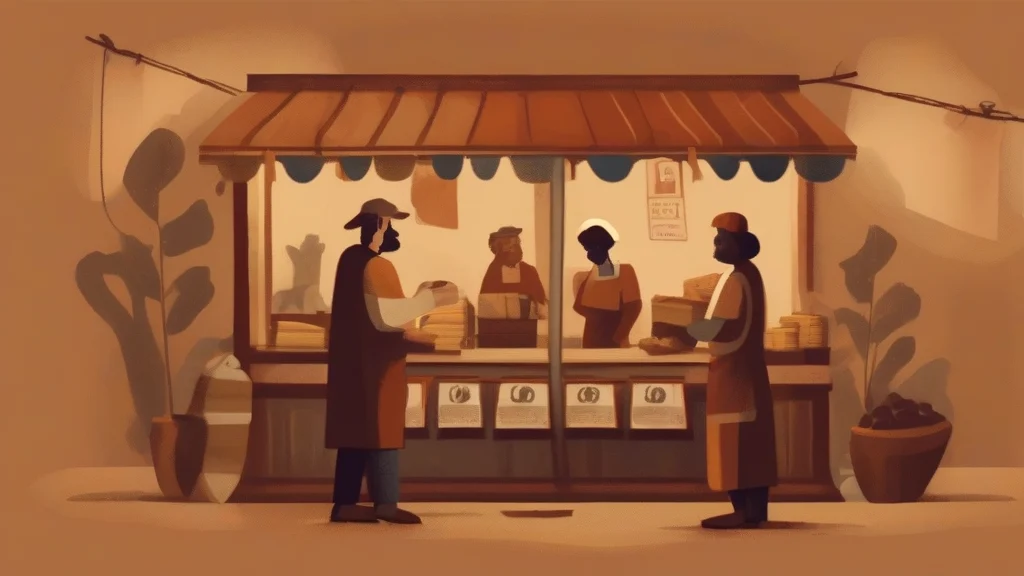
Bartering is the direct exchange of goods or services for other goods or services without money serving as an intermediary. A farmer might trade grain for cloth, or a web designer might build a website in return for accounting help. As a noun, "bartering" usually refers to the practice as a whole rather than a single transaction, and it appears most often in discussions of economics, history, and anthropology, where it describes systems of trade that predate coined money. In modern usage it also surfaces in contexts of scarcity, informal economies, and community exchange schemes, where people bypass cash altogether. The term carries connotations of simplicity, self-sufficiency, and sometimes hardship, since communities often turn to bartering when currency fails or is unavailable. While closely related to trading and haggling, bartering is distinguished by the complete absence of money. It remains a useful concept for understanding both ancient economies and contemporary alternatives to cash-based commerce.
nounThe exchange of goods or services directly for other goods or services without using money as an intermediary.
- The practice or act of exchanging goods or services directly for other goods or services without the use of money.
"In the village market, bartering was still common long after cash had taken over in the cities."
"During the crisis, when currency lost its value, families survived by bartering bread for firewood."
"The farmers' cooperative encouraged bartering among members, letting one grower swap surplus eggs for another's vegetables."
Long before coins existed, entire economies ran on bartering — and it's making a quiet comeback whenever cash runs short.
Reviewed by Deb Chak, Editor. AI-assisted content curated by RJS Tech Solutions LLP.
Etymology of bartering
Bartering entered English via the verb "barter," which appeared in English by the late 14th century, borrowed from Old French "barater," a term associated with exchange and also with deception or trickery. The ultimate deeper origins of the Old French word are debated among scholars, so its earliest ancestry cannot be stated with certainty. The gerund form "bartering" developed naturally from the verb as English speakers needed a name for the practice itself. Its closest relatives are simply the other forms of the same verb, such as "barter" and "barterer."
Related word forms
How bartering is actually used
"Bartering" is most often used as a mass noun referring to the general practice rather than a single act of exchange. It carries slightly old-fashioned or anthropological connotations, appearing frequently in discussions of pre-monetary economies, historical trade, and informal or cash-strapped modern exchanges. The verb form "barter" is more common in everyday speech than the noun "bartering."
Easily confused with bartering
Haggling is negotiating over the price of something sold for money, whereas bartering is exchanging goods or services directly without any money changing hands.
Trading is a broader term that includes monetary transactions, while bartering specifically refers to moneyless direct exchange.