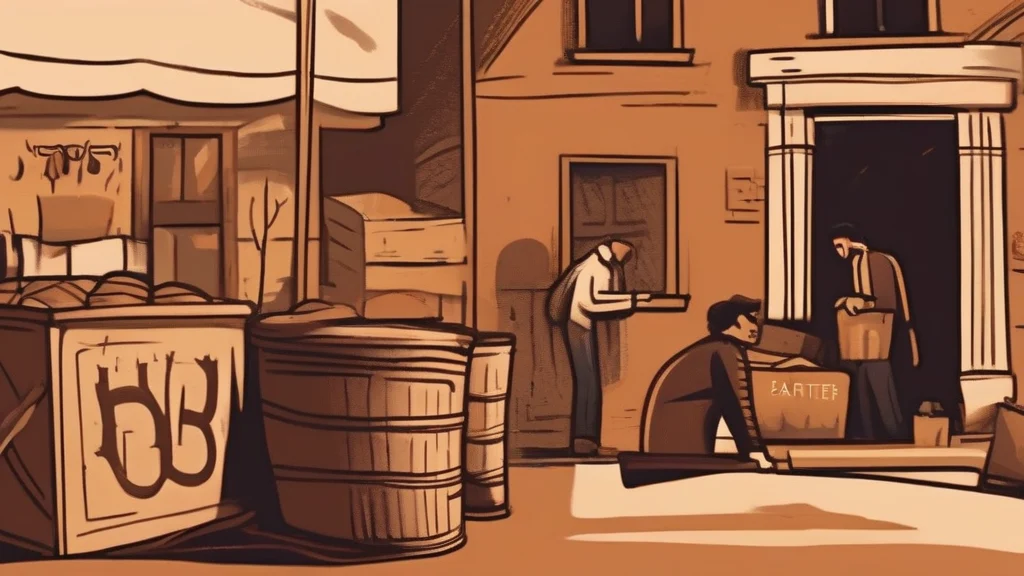
What does barter mean?
Barter refers to the direct exchange of goods or services for other goods or services, without money acting as an intermediary. It can function as both a noun, describing the system or act of such exchange, and a verb, describing the action of trading this way. Historically, barter is associated with early economies before the invention of currency, and it persists today in informal trading, local exchange networks, and situations where cash is scarce or unreliable. The word carries a neutral connotation, though it can evoke a sense of old-fashioned simplicity or resourcefulness. In economics, barter is often discussed as a contrast to monetary systems because it requires a 'double coincidence of wants' — each party must want exactly what the other offers. Related terms include trade, swap, and exchange, though barter specifically implies the absence of money in the transaction.
The exchange of goods or services directly for other goods or services without using money.
"The tribe relied on barter to obtain salt from neighboring settlements."
To exchange goods or services for other goods or services rather than for money.
"They bartered their surplus crops for tools at the seasonal fair."
Rarely used; 'barter' is usually treated as an uncountable noun referring to the practice or system of exchange.
"Historical records mention occasional barters between distant trading partners."
Before money existed, barter was the original marketplace — but economists note it's surprisingly inefficient, which is exactly why currency was invented.
Reviewed by Deb Chak, Editor. AI-assisted content curated by RJS Tech Solutions LLP.
Etymology of barter
Barter entered English in the late Middle Ages, likely borrowed from French 'barater' meaning to trade or deceive, with possible earlier roots in Old French and related Romance forms. It has cognates in several European languages that developed from similar commercial vocabulary. The word's association with non-monetary exchange became firmly established as monetary economies spread across Europe.
Related word forms
How barter is actually used
Barter is neutral in register and appears in both everyday speech and economic writing. It often carries a slightly old-fashioned or informal connotation in modern usage, since most economies rely on money, though it remains common in contexts of scarcity, informal trade, and international sanctions relief.
Easily confused with barter
Banter is playful, teasing conversation, while barter is the exchange of goods or services without money.