
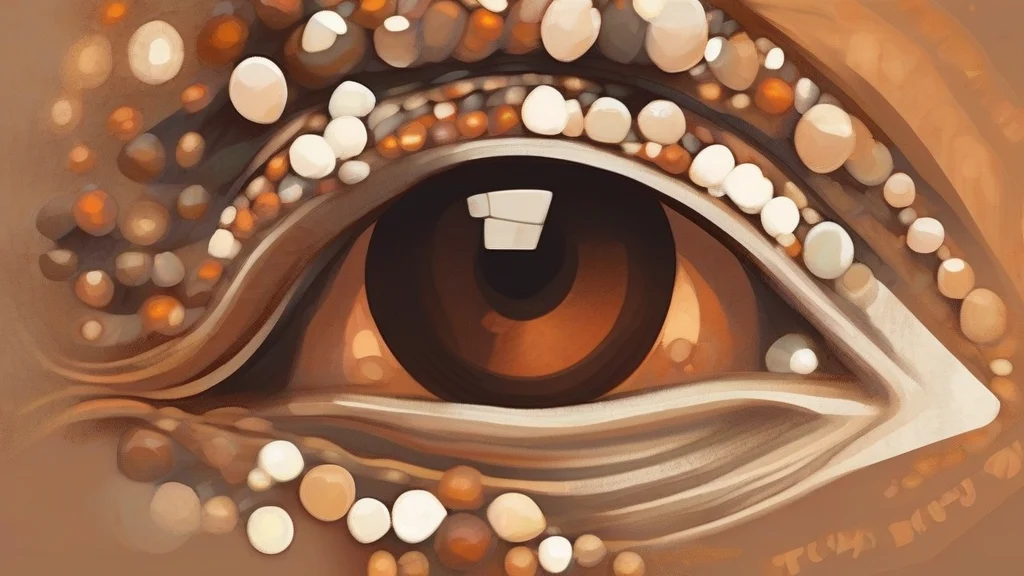
What does beady mean?
Beady is an adjective used chiefly to describe eyes that are small, round, hard, and shiny — like polished beads. It appears most commonly in the phrase 'beady eyes', applied to people, animals (especially birds and rodents), and occasionally characters in fiction to suggest alertness, cunning, or an unsettling intensity of gaze. A secondary sense describes anything small, round, and bead-like in appearance. The word derives from 'bead', whose older sense referred to a small drop or ball, and it entered English by the straightforward route of resemblance: an eye so round and glistening seemed literally made of beads. Though neutral in itself, 'beady' frequently carries a slightly negative colouring, evoking scrutiny or menace — a villain's beady glare is a stock image in storytelling. It remains informal-to-neutral in register and common throughout the English-speaking world.
adjectiveSmall, round, and hard-looking, especially in reference to the eyes; resembling or set with beads.
- (of eyes) small, round, and gleaming or glittering
- resembling a bead; small and rounded
"The old sailor watched us with beady eyes from beneath his cap."
"The raven fixed its beady eye on the crumbs at my feet."
"She threaded the tiny, beady pearls onto a fine wire."
A bird's eye is called 'beady' because it looks like a tiny polished bead — which is exactly where the word comes from.
Reviewed by Deb Chak, Editor. AI-assisted content curated by RJS Tech Solutions LLP.
Etymology of beady
Beady is formed simply from 'bead' plus the adjectival suffix '-y', first appearing in English in the early 19th century. Its origin rests on the noun 'bead', which itself descends from Old English 'gebed' meaning 'prayer'; the counting of prayers on a rosary led to the small balls being called beads, and the word then broadened to any small perforated ball. When writers needed a word for eyes that glinted like tiny polished spheres, 'beady' was the natural coinage, and it has remained closely tied to that image ever since.
How beady is actually used
Most often used attributively before a noun, almost exclusively with 'eyes'. The figurative sense can carry a slightly sinister or watchful connotation when describing a person's gaze.
Easily confused with beady
'Beady' describes small round glittering eyes or something resembling beads, while 'bearded' means having a beard.