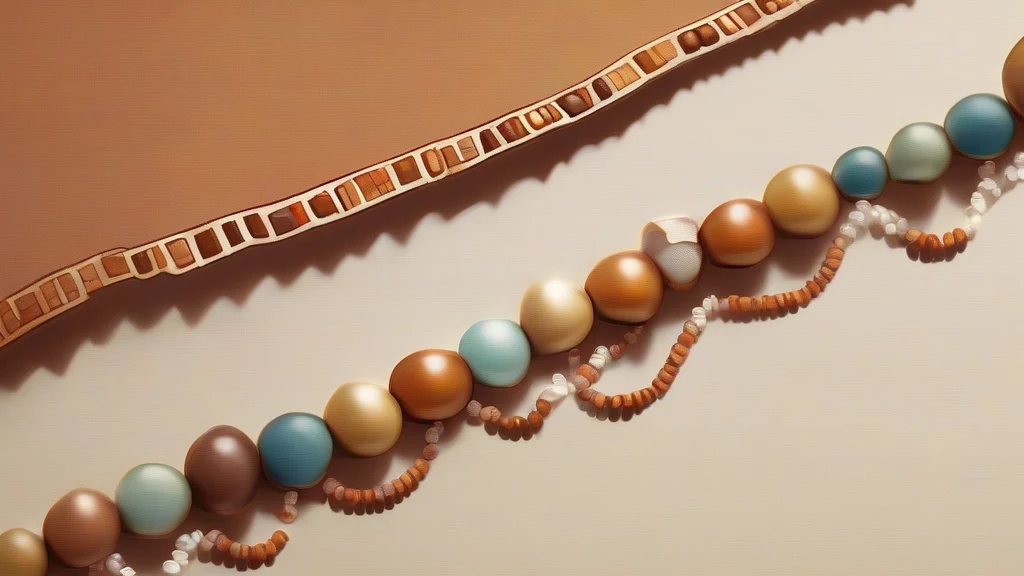
What does beading mean?
Beading is the collective term for beads — small perforated balls of glass, plastic, metal, wood, or gemstone — especially when they are strung, sewn, or otherwise applied as decoration to clothing, jewellery, or household objects. A wedding gown shimmering with tiny glass beads is said to feature beading, and the craft of applying them is closely related to beadwork. The word also has a second life in construction and furniture-making, where beading names a narrow, rounded moulding that resembles a row of beads and is used to trim edges, panel joints, and drawer fronts. More loosely, beading can describe any liquid gathering into small round drops, such as water beading on a waxed car. Across all its senses, the word evokes ornament, precision, and careful handwork, making it common in discussions of fashion, costume design, antiques, and traditional crafts.
nounBeads collectively, especially as sewn or strung onto fabric, clothing, or jewellery; also the narrow decorative moulding resembling a row of beads used in architecture and carpentry.
- Beads collectively, especially as decoration sewn or strung onto clothing, accessories, or jewellery.
- A narrow, rounded decorative moulding resembling a string of beads, used in architecture, furniture, and carpentry (also called bead moulding).
- Material in small rounded drops or beads, such as condensation forming in beads on a surface.
"The evening gown was covered in delicate beading that caught the light with every movement."
"She spent months hand-stitching the beading onto her wedding gown."
"The craftsman finished the cabinet doors with a fine beading along each edge."
Rarely used; beading is normally uncountable. A plural may appear in technical contexts referring to multiple strips or types of bead moulding.
"The workshop stocked several beadings for different trim profiles."
The word 'bead' originally meant 'prayer' — the small balls on a rosary were literally counted prayers, which is why we still 'tell our beads'.
Reviewed by Deb Chak, Editor. AI-assisted content curated by RJS Tech Solutions LLP.
Etymology of beading
Beading derives from 'bead', which comes from Old English 'gebed' meaning 'prayer', related to the verb 'bid' (to pray or ask). The sense shifted because rosaries used small balls to count prayers, so by the Middle English period 'bead' had come to mean the prayer-counter itself and then the little ball. The noun 'beading' arose from adding the '-ing' suffix to form a collective or material noun, and the architectural sense developed by analogy with the rounded profile of a string of beads.
Related word forms
How beading is actually used
Beading is almost always treated as an uncountable (mass) noun when referring to beads as decoration or material. In woodworking and architecture it is often called 'bead' or 'bead moulding', with 'beading' emphasizing the strip of moulding itself. The word carries connotations of craftsmanship, ornament, and often luxury or formality in fashion contexts.
Easily confused with beading
Bidding means offering a price at an auction, while beading refers to beads or bead-like decoration.