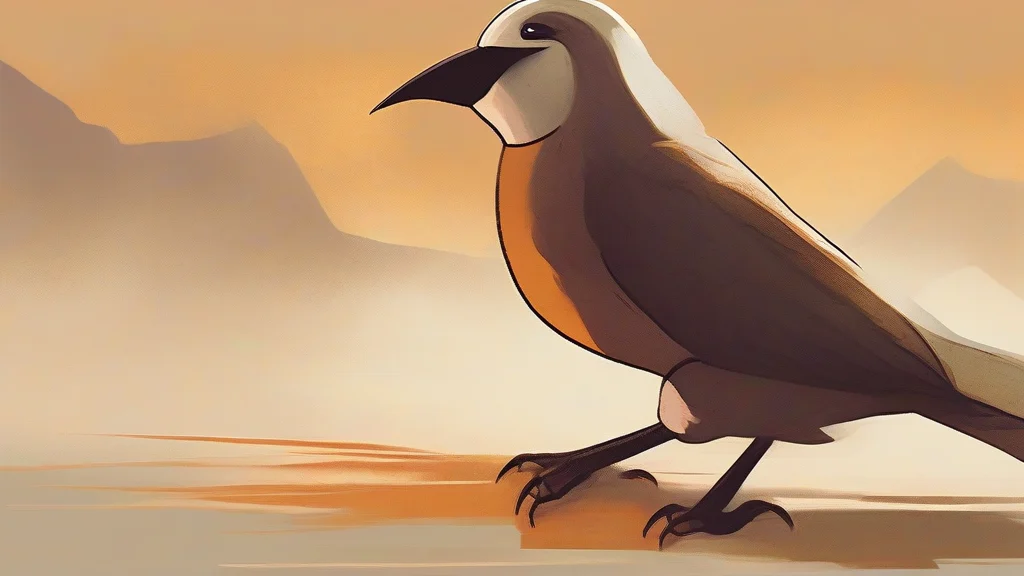
What does beaked mean?
"Beaked" is an adjective meaning having a beak, most often used with a modifier that specifies the beak's character — as in "long-beaked", "short-beaked", or "sharp-beaked". It appears constantly in zoological writing, where the shape and size of a bird's bill is one of the chief features used to distinguish species, and it extends naturally to other animals such as the short-beaked echidna. Beyond biology, the word can describe anything resembling a beak in form: a pointed prow, a projecting architectural feature, or a hooked tool. The term carries a neutral, descriptive tone rather than any strong connotation, making it useful wherever precision matters more than colour. Derived simply from the noun "beak" plus the adjectival suffix "-ed", it follows a productive English pattern — like "winged" or "horned" — that turns a body part into a compact, vivid descriptor. For writers, it offers an economical way to evoke a bird's silhouette or a sharp, pointed profile in a single word.
Having a beak, especially one of a specified size, shape, or colour.
"The yellow-beaked finch cracked seeds at the edge of the feeder."
Typically modified; unqualified use is uncommon because most birds are assumed to have beaks.
Resembling or shaped like a beak; ending in a pointed or hooked projection.
"The vessel's beaked prow was built to splinter opposing hulls in battle."
The humble suffix "-ed" turns a bird's most iconic feature into a precise scientific label — which is why ornithologists describe species as long-billed, short-beaked, or even sickle-beaked.
Reviewed by Deb Chak, Editor. AI-assisted content curated by RJS Tech Solutions LLP.
Etymology of beaked
The adjective "beaked" is formed straightforwardly from the noun "beak" combined with the suffix "-ed", which creates adjectives meaning "provided with" or "characterised by". The noun "beak" entered English in the Middle English period, borrowed from Old French "bec", which in turn derives from Latin "beccus" — a word of likely Gaulish (Celtic) origin. The same Latin root underlies related Romance forms such as modern French "bec". The compound pattern seen in "long-beaked" and "short-beaked" reflects a long-standing English habit of forming descriptive animal epithets with body-part adjectives.
Related word forms
How beaked is actually used
Almost always used attributively or predicatively with a modifier specifying the kind of beak (e.g. "yellow-beaked", "hook-beaked"); bare "beaked" on its own is rare and somewhat tautological, since birds are generally assumed to have beaks. Common in ornithological and zoological description, and occasionally extended figuratively to objects with a pointed, beak-like projection.
Easily confused with beaked
"Baked" means cooked by dry heat in an oven, while "beaked" means possessing a beak — they differ only in their initial consonant sound.