
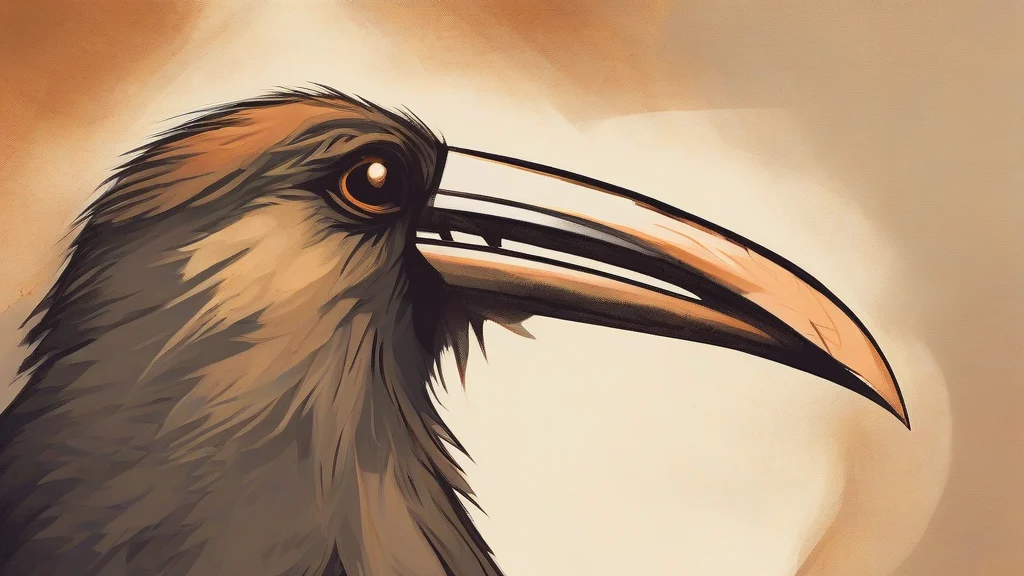
What does beak mean?
A beak is the hard, pointed structure that forms the mouth of a bird, made of keratin — the same protein found in human nails — rather than bone-covered teeth. Consisting of an upper and lower mandible, it serves as a bird's all-purpose tool: cracking seeds, tearing flesh, probing bark, preening feathers, building nests, and even fighting rivals. Its shape is closely matched to diet, from the conical bills of finches built for seeds to the long curved beaks of raptors and hummingbirds' slender drinking straws. The word extends naturally to similar mouthparts in other creatures, such as the formidable keratin beaks of octopuses and squid and the toothless jaws of turtles. Beyond biology, 'beak' appears in informal British speech as an old nickname for a magistrate, and adjectives like 'beaked' and 'beaky' describe prominent noses or beak-like features.
The hard, pointed projecting mouth of a bird, formed of keratinous upper and lower mandibles, used for eating, grooming, and other tasks.
"The pelican's enormous beak can hold far more than its belly."
Ornithologists often prefer the term 'bill'; 'beak' is standard in general use.
Any similar beak-like mouthpart or jaw structure in other animals, such as turtles, squid, or insects.
"Squid slice their prey with a chitinous beak hidden at the base of their arms."
(British, dated slang) A magistrate or judge; formerly also a schoolmaster.
"The old novels describe the prisoner being hauled before the beak at Bow Street."
Regular plural; used both literally for multiple birds' bills and figuratively for beak-like structures.
"The ducklings pecked at the bread with their tiny yellow beaks."
A beak isn't teeth gone missing — it's a single blade of keratin, the same stuff as your fingernails, grown into one of nature's most versatile tools.
Reviewed by Deb Chak, Editor. AI-assisted content curated by RJS Tech Solutions LLP.
Etymology of beak
'Beak' entered Middle English around the fourteenth century, most likely through Old French 'bec', which itself derives from Latin 'beccus', a word believed to have been borrowed from Gaulish, a Celtic language of ancient France. The ultimate Celtic root is uncertain, but the word has been applied to bird bills and similar pointed structures ever since. The adjective 'beaked' and the colloquial 'beaky' developed directly from the noun in later English.
Related word forms
How beak is actually used
In ornithology and careful usage, 'bill' is often preferred for birds, with 'beak' more common in everyday speech. In British informal usage, 'beak' has long served as slang for a magistrate or judge, and in older school slang for a strict teacher; both are dated today.
Easily confused with beak
A 'peak' is the highest point of something such as a mountain or level of activity, whereas a 'beak' is a bird's bill — they rhyme but share nothing in meaning.
To 'peek' means to glance quickly or secretly, while a 'beak' is the horny bill of a bird.