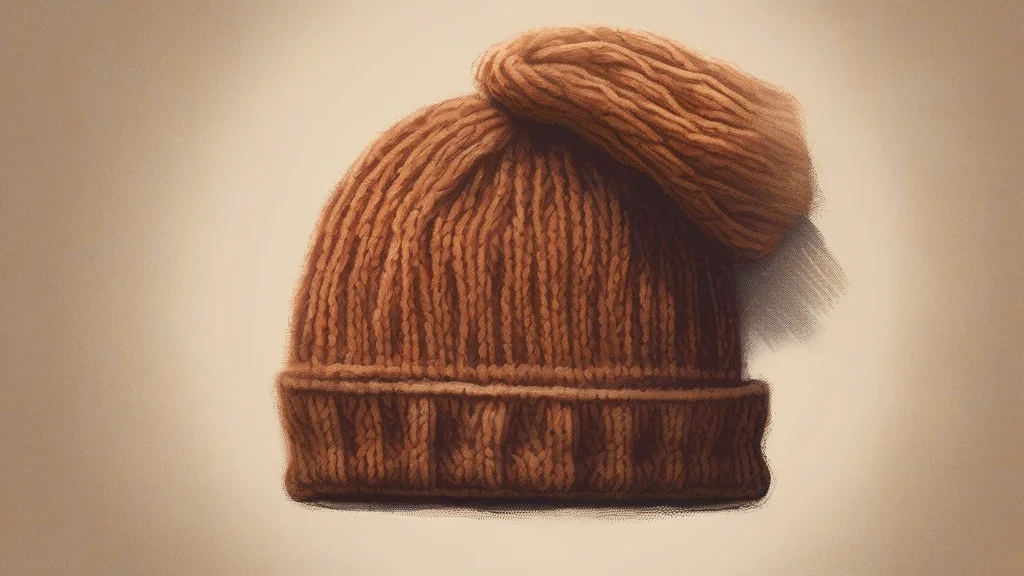
What does beanie mean?
A beanie is a small, close-fitting cap without a brim, usually knitted from wool or a similar soft material and worn pulled snugly over the ears. It is one of the most common items of winter headwear in both Britain and the United States, prized for being lightweight, packable, and warm. The word's origin is playful: it derives from early twentieth-century American slang that referred to the head as a "bean," so a beanie was originally a "bean" cap. Beyond everyday winter wear, "beanie" also has a historical American sense — a stiff, flat-topped cap once worn by new university students to mark their freshman status, sometimes decorated with a propeller or school colors. Today the word carries casual, youthful connotations and appears frequently in fashion contexts. Its synonyms vary by region: Americans may say knit cap or watch cap, while Britons might say bobble hat or toque for similar garments.
A small, close-fitting brimless cap, typically knitted, worn for warmth or as a fashion accessory.
"Everyone at the ski lodge wore a brightly colored beanie."
The dominant modern sense in both British and American English.
(Historical, US) A stiff, flat-topped cap formerly worn by college freshmen to indicate their status.
"Freshmen were required to wear a green beanie until the homecoming game."
Largely obsolete; found mainly in historical accounts of early-to-mid twentieth-century American universities.
Regular plural formation; used when referring to multiple caps.
"The store sells beanies in every color imaginable."
The name likely comes from "bean" — in early 20th-century American slang, calling someone's head a "bean," so a beanie was literally a "bean cap."
Reviewed by Deb Chak, Editor. AI-assisted content curated by RJS Tech Solutions LLP.
Etymology of beanie
"Beanie" originated in early twentieth-century American English as an informal diminutive of the slang use of "bean" to mean the head. The earliest beanies were simple skullcaps; by the 1910s–1920s the word was well established in American colleges, where stiff versions became part of freshman tradition. Over time the term broadened to cover any snug brimless knit cap, and this sense is now standard throughout the English-speaking world.
How beanie is actually used
Informal to neutral register. In British English the word most often implies a knitted cap (often called a bobble hat if it has a pompom), while American English uses "beanie" broadly for any snug knit cap. The older US sense of a stiff freshman cap is now largely historical.
Easily confused with beanie
"Beanie" is a type of hat, whereas a "Beanie Baby" (proper noun) refers to the popular stuffed toys sold by Ty Inc. in the 1990s.