What does beanstalk mean?
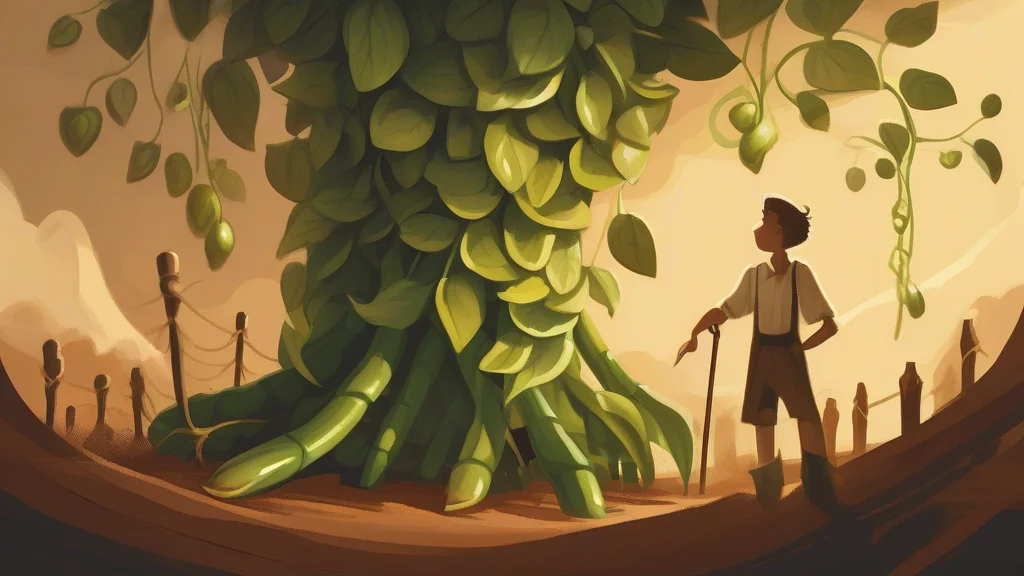
A beanstalk is the main vertical stem of a bean plant, the structure from which leaves, flowers, and pods develop. Gardeners encounter it as an everyday feature of growing beans, whether dwarf bush varieties or tall climbing ones supported by poles and trellises. Yet for most English speakers, the word carries a far more vivid charge: it is inseparable from 'Jack and the Beanstalk', the centuries-old fairy tale in which a boy trades a cow for magic beans and wakes to find a colossal stalk stretching from his garden into the clouds, where a fearsome giant awaits. This literary association makes 'beanstalk' one of those rare botanical terms with strong narrative connotations, so much so that writers use it figuratively for anything improbably tall or rapidly growing. Whether describing a vegetable patch or evoking a world of giants, castles, and stolen treasure, the word reliably conjures images of upward growth and adventure.
The main stem of a bean plant, especially when tall or climbing.
"She tied each young beanstalk carefully to its bamboo cane."
In everyday gardening contexts the plural 'beanstalks' is common.
An enormous, typically magical beanstalk, especially the one climbed by Jack in the fairy tale 'Jack and the Beanstalk'.
"The children imagined a beanstalk rising out of their own garden and leading to a castle above the clouds."
Regular plural; used when referring to multiple bean plants' stems or multiple instances of the magical stalk in different tellings.
"By midsummer, a row of sturdy beanstalks lined the entire south wall of the garden."
In the classic tale, Jack trades his family's only cow for magic beans — and overnight, a beanstalk grows all the way up to a giant's castle in the sky.
Reviewed by Deb Chak, Editor. AI-assisted content curated by RJS Tech Solutions LLP.
Etymology of beanstalk
Beanstalk is a compound of two native Germanic words: 'bean', from Old English 'bēan' meaning the seed or pod-bearing legume, and 'stalk', from Old Norse-influenced 'stalca'/'stalka' meaning the stem of a plant. The compound arose naturally within English, likely by the early modern period as gardeners needed a term for the bean plant's central stem. Its cognates lie not in Latin or Greek but across the Germanic languages: Dutch 'boon', German 'Bohne' share ancestry with 'bean', while related forms of 'stalk' appear in other Germanic dialects.
How beanstalk is actually used
The literal horticultural sense is ordinary and unmarked. The word is strongly associated with the fairy tale 'Jack and the Beanstalk', so figurative or whimsical uses almost always evoke that story.
Easily confused with beanstalk
A vine is any climbing or trailing plant stem; 'beanstalk' specifically denotes the main upright stem of a bean plant, especially in the context of the fairy tale.