
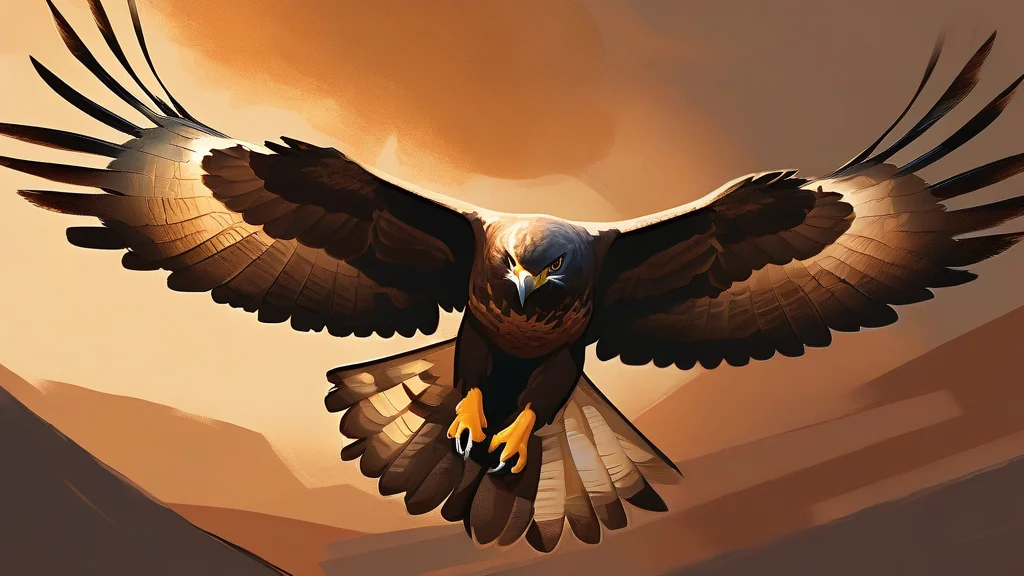
What does hawk mean?
Hawk most commonly names a bird of prey, a keen-eyed hunter of the hawk family. It also has a long-standing political sense: a “hawk” is someone who favours forceful action, especially military intervention, whereas a “dove” prefers negotiation and restraint. As a verb, hawks can mean to watch or search for something with intense suspicion, or to sell goods aggressively by approaching people directly and promoting the products insistently. These meanings share an association with the hawk’s alertness, predatory power, and forward-moving aggression. The word is useful because it links an ordinary observation of nature with a precise vocabulary for international politics, though the political and selling senses can sound confrontational or informal respectively. The related forms “hawkish,” “hawking,” and “hawker” preserve several of these associations in modern English.
A hawk is a diurnal bird of prey, especially a member of the family Accipitridae. By extension, it can mean a person who advocates aggressive political or military action.
"A red-tailed hawk watched from the edge of the field."
The political sense is usually encountered in discussion of diplomacy, warfare, or party politics.
To hawk means to watch or search for something with intense attention, or to sell goods aggressively. It can also mean to move or search with the persistent curiosity associated with a hawk.
"Reporters hawked outside the ministry while officials issued their statement."
The selling sense is informal and somewhat old-fashioned in British English; the watchful sense is usually more informal still.
The standard plural of the noun is “hawks”; in British English, “hawks” can also be the third-person singular present of the verb in the sense of selling goods.
"Several hawks circled above the ridge while the flock of songbirds crossed the valley."
From fierce hunter to fierce policy: the hawk's aggressive reputation gave military hardliners their name.
Reviewed by Deb Chak, Editor. AI-assisted content curated by RJS Tech Solutions LLP.
Where does hawk come from?
The noun comes from Old English hafoc, the attested Old English name for a bird of prey, and ultimately from a Proto-Germanic root also represented in modern Dutch and German words for hawks. The political sense developed from the bird's association with fierce hunting and aggressive attack. The separate commercial sense of “hawk” developed from the older use of hawking, originally the practice of hunting with trained birds of prey.
Related word forms
How hawk is actually used
As a bird name, “hawk” is standard and broadly used. In political contexts, “hawk” can be mildly accusatory, while “hawkish” is the usual adjective for a policy of confrontation or military force. As a verb meaning to sell aggressively, it is informal and somewhat dated in British English but remains understood and used in American English.
Easily confused with hawk
Hawks generally belong to the hawk family Accipitridae, while falcons belong to the falcon family Falconidae, although common naming does not always distinguish them cleanly.