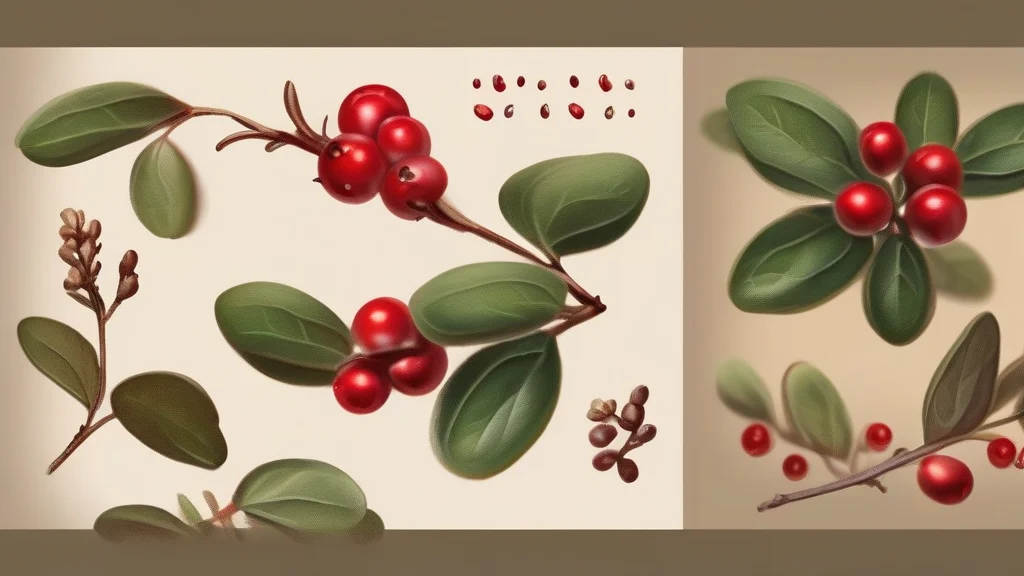
What does bearberry mean?
Bearberry is the common name for a low-growing, mat-forming evergreen shrub of the genus Arctostaphylos, most notably Arctostaphylos uva-ursi, which thrives across northern Europe, Asia, and North America. It bears small, leathery, spoon-shaped leaves and clusters of tiny bell-like flowers that develop into smooth, bright red berries. Although technically edible, the berries are bland and mealy, and they take their English name from the fact that bears eat them eagerly — an association preserved in its botanical name too, since 'Arctostaphylos' derives from Greek words meaning 'bear' and 'bunch of grapes', while 'uva-ursi' is Latin for 'grape of the bear'. The plant is valued as ornamental ground cover on poor, sandy soils and is well known in herbal tradition, where its dried leaves — sometimes called uva ursi — have been used for urinary ailments. In North America the name kinnikinnick is also common, particularly for the leaves used historically in smoking mixtures.
nounA low-growing evergreen shrub of northern regions, Arctostaphylos uva-ursi, with small leathery leaves and red berries; also, one of these edible but insipid berries, which bears are known to eat.
- The evergreen shrub Arctostaphylos uva-ursi and its close relatives, native to northern Europe, Asia, and North America.
- The small round red berry produced by this shrub.
"The rocky tundra was carpeted with bearberry, its scarlet berries glowing against the dark green foliage."
"Ground cover of bearberry and juniper stabilized the sandy soil along the ridge."
"Herbalists have long valued dried bearberry leaf as a traditional remedy for urinary complaints."
Standard plural, following the regular y → ies pattern shared by other -berry compounds such as 'mulberries' and 'elderberries'. Used both for individual fruits and for multiple plants or patches of the shrub.
"The hikers gathered handfuls of ripe bearberries along the trail."
Its scientific name, Arctostaphylos uva-ursi, translates as 'bear grape' in both Greek and Latin — botanists were so struck by bears eating it that they named it twice.
Reviewed by Deb Chak, Editor. AI-assisted content curated by RJS Tech Solutions LLP.
Etymology of bearberry
Bearberry is an English compound of 'bear' and 'berry', first recorded around the early seventeenth century, named for the animal famously fond of its fruit. The binomial Arctostaphylos uva-ursi echoes this folk etymology in learned form: Greek arktos ('bear') plus staphylē ('grape'), combined with Latin uva ursi ('bear's grape'). It belongs to the same large family of '-berry' compounds as bilberry, mulberry, elderberry, and cranberry.
Related word forms
How bearberry is actually used
Bearberry is primarily a botanical and natural-history term, common in writing about northern flora, gardening, and herbal medicine rather than everyday conversation. In North America it is also widely known by the Algonquian-derived name 'kinnikinnick', especially in reference to its leaves, which were traditionally smoked in mixtures.
Easily confused with bearberry
Bilberry is a different plant entirely — a shrubby European blueberry relative with dark blue fruit — whereas bearberry is a low ground-cover shrub with bright red berries.