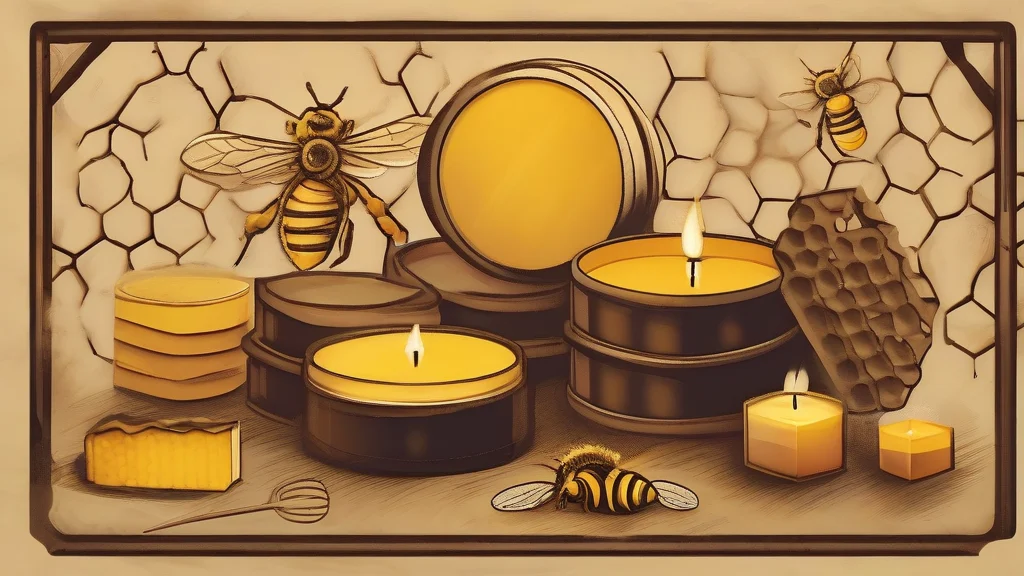
What does beeswax mean?
Beeswax is the waxy substance secreted by worker honeybees from glands on their abdomens, which they use to build the hexagonal cells of the honeycomb. Ranging in color from pale yellow to deep brown depending on its source and processing, it has been prized by humans since antiquity for making candles, wood and leather polishes, cosmetics such as lip balm and cold cream, food coatings, and even encaustic paint. Because bees produce only small quantities — consuming substantial stores of honey to make each pound of wax — genuine beeswax remains relatively costly compared with paraffin or soy alternatives. In modern usage the word appears both literally, in crafts and product labels, and figuratively in the humorous Americanism "mind your own beeswax," meaning to stop prying into someone else's affairs. It is an uncountable noun, so it normally takes a singular verb and has no common plural form.
nounThe yellow-to-brown waxy substance secreted by honeybees, used by them to build honeycomb and by humans for making candles, polishes, cosmetics, and other products.
- The natural wax secreted by honeybees and used to construct honeycomb cells.
- A commercial product made from this wax, used in candles, polishes, cosmetics, and food glazes.
"She sealed the letter with a drop of melted beeswax and pressed her ring into it."
"The furniture gleamed after she buffed it with a traditional beeswax polish."
"Artisans still prefer beeswax candles because they burn slowly and give off a faint honey scent."
Standard usage treats beeswax as an uncountable mass noun with no plural. A plural appears only in technical contexts distinguishing varieties or grades of wax.
"The supplier stocks several beeswaxes, from raw unfiltered to fully refined cosmetic grade."
Bees must eat roughly eight pounds of honey to make just one pound of the wax they build their honeycomb from — which is why real beeswax candles have always been a luxury.
Reviewed by Deb Chak, Editor. AI-assisted content curated by RJS Tech Solutions LLP.
Etymology of beeswax
Beeswax is a compound of Old English elements: "bee" (Old English bēo, from a Germanic root) and "wax" (Old English weax, shared with German Wachs and Dutch was). The compound itself is attested in early Middle English and has remained stable in form for centuries. Its Germanic cousins preserve the same pairing, reflecting the long-standing importance of beekeeping across northern Europe.
How beeswax is actually used
Beeswax is an uncountable (mass) noun and takes singular verb agreement; it has no ordinary plural except when referring to different grades or types in technical contexts. The informal phrase "mind your own beeswax" is a playful variant of "mind your own business," popular especially in American English.