
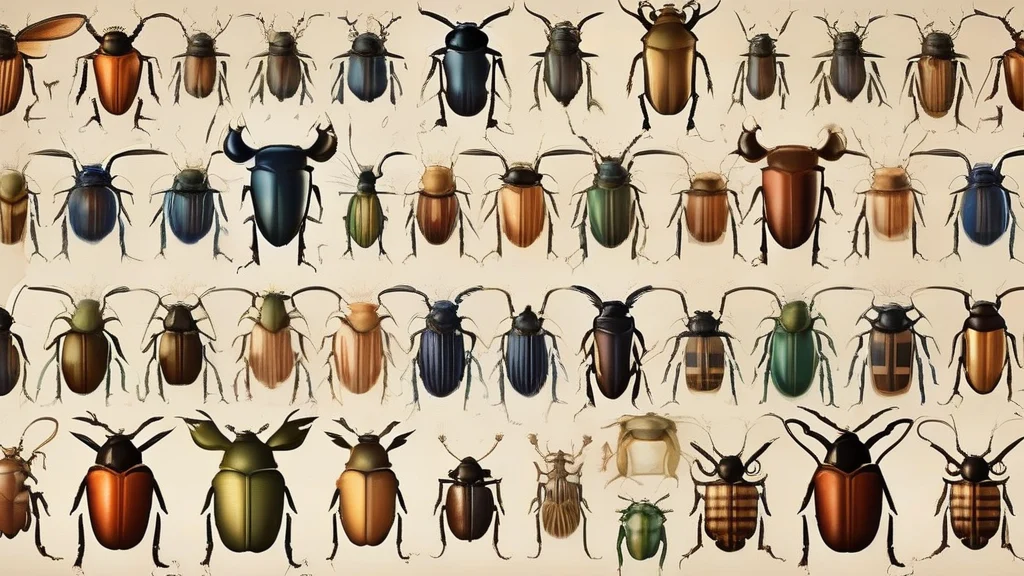
What does beetle mean?
A beetle is an insect belonging to the order Coleoptera, distinguished by a pair of hardened forewings, called elytra, that close like a case over the delicate flying wings beneath. This armored design has made beetles extraordinarily successful: they are found in nearly every land and freshwater habitat on Earth, and entomologists estimate that roughly one in four described animal species is a beetle. Familiar examples include the ladybird, dung beetle, stag beetle, and firefly. In everyday English the noun carries no particular emotional charge, though certain species attract affection or revulsion depending on context. The word also functions as a verb, most often in informal British usage where someone 'beetles off,' meaning to hurry or bustle away. A further, now largely literary sense describes rock faces or brows that 'beetle' over something — jutting out ominously. Derived forms such as 'beetling' and the adjective 'beetle-browed' preserve this older figurative use.
An insect of the order Coleoptera, having hard front wings (elytra) that cover and protect the folded hind wings and abdomen.
"A green tiger beetle darted across the sandy path."
Standard in all registers.
(Chiefly British, informal) To move quickly or scurry away, usually in the phrase 'beetle off'; also (literary) of a cliff or brow, to jut or overhang.
""Time to beetle off," he said, hopping on his bike."
The 'hurry away' sense is British and informal; the 'overhang' sense appears mostly in literary description, typically in the present participle 'beetling'.
Regular plural; used both for multiple insects and generically for the group.
"Dung beetles play a vital role in recycling nutrients in grassland ecosystems."
Beetles are so successful that roughly one in four known animal species on Earth is a beetle — prompting biologist J.B.S. Haldane's famous quip that God has 'an inordinate fondness for beetles.'
Reviewed by Deb Chak, Editor. AI-assisted content curated by RJS Tech Solutions LLP.
Etymology of beetle
'Beetle' descends from Old English 'bitela', a derivative of the verb 'bītan' ('to bite'), reflecting the biting mouthparts of these insects; it is thus related to modern words such as 'bite'. The spelling was influenced in Middle English by related forms such as 'bitelbrow', which gave rise to 'beetle-browed'. The verb senses developed later from the noun and from the image of a protruding beetle brow.
Related word forms
How beetle is actually used
As a noun, 'beetle' is standard and neutral in all registers. The verbal sense 'to beetle' meaning to hurry away is chiefly British and informal, often in the phrase 'beetle off.' The literary sense of 'beetling' describing overhanging rocks survives mainly in descriptive or poetic prose.
Easily confused with beetle
'Beatle' refers only to a member of the Beatles band or their fans, while 'beetle' is the insect.