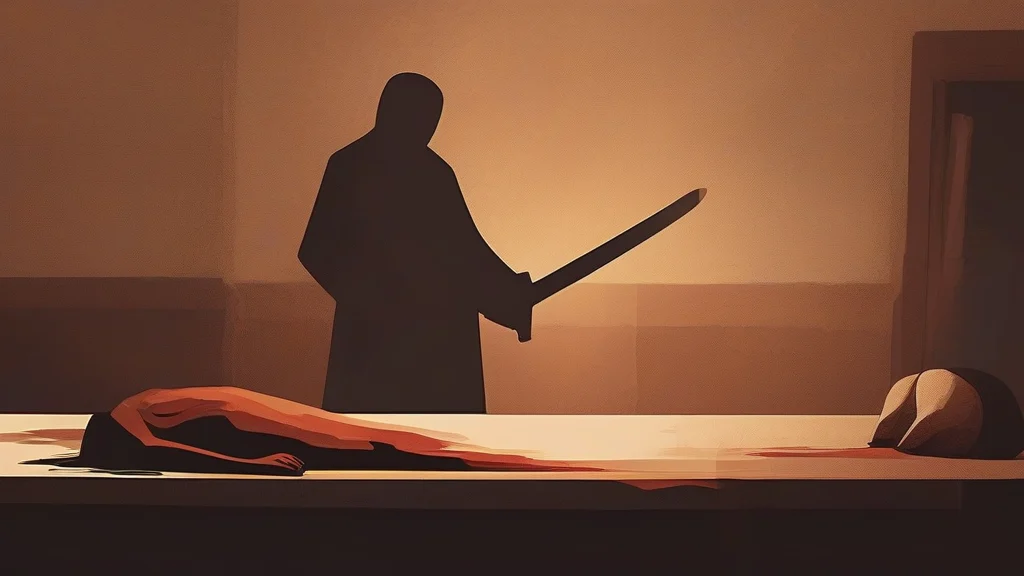
What does beheaded mean?
"Beheaded" is the past tense and past participle of the verb "behead," meaning to cut off a person's or animal's head. Historically, it most commonly describes judicial executions carried out by axe or sword, a punishment long associated with European royalty and nobility—figures such as Anne Boleyn and Mary, Queen of Scots were famously beheaded. Today the word appears chiefly in history writing, journalism, and legal reporting, though it can also describe decapitated statues or figures damaged by accident or vandalism. The term carries strong, inherently violent connotations, so writers typically reserve it for contexts where precision matters rather than using it casually. It derives from Middle English, combining the prefix "be-" with "head." Related forms include the verb "behead" and the noun "beheading," which names the act itself. Because the word describes a specific, irreversible act, its use tends to lend gravity and finality to any sentence in which it occurs.
verb (past tense and past participle)Past tense and past participle of 'behead': to have cut off someone's head, especially as a form of execution.
- To have cut off the head of a person or animal, especially as a formal act of execution or punishment.
"Anne Boleyn was beheaded at the Tower of London in 1536."
"Mary, Queen of Scots, was beheaded at Fotheringhay Castle in 1587."
"The statue had been beheaded by vandals sometime overnight."
Between 1485 and 1603, being beheaded was such a common fate for Tudor courtiers that Anne Boleyn reportedly joked about her executioner's famously sharp French sword.
Reviewed by Deb Chak, Editor. AI-assisted content curated by RJS Tech Solutions LLP.
Etymology of beheaded
"Behead" was formed in Middle English from the prefix "be-," used to make transitive verbs, combined with "head," from Old English "hēafod." The word emerged as a native Germanic construction, replacing earlier French-derived terms such as "decapitate" in everyday use, though both now coexist with "behead" being plainer and more direct. Its cognates are other English compounds built on the same ancient Germanic root for "head," including "forehead," "overhead," and "headline."
Related word forms
How beheaded is actually used
The word is largely neutral-to-formal in register but carries inherently violent connotations, so it is used sparingly outside historical, legal, and news contexts. In modern usage it appears most often in historical accounts of executions, particularly those of European royalty, and in reports of violent crime or acts committed by extremist groups, where style guides often advise care and restraint.
Easily confused with beheaded
'Beholden' means obligated or indebted to someone, while 'beheaded' refers to having one's head cut off; they share a similar sound but entirely different meanings.