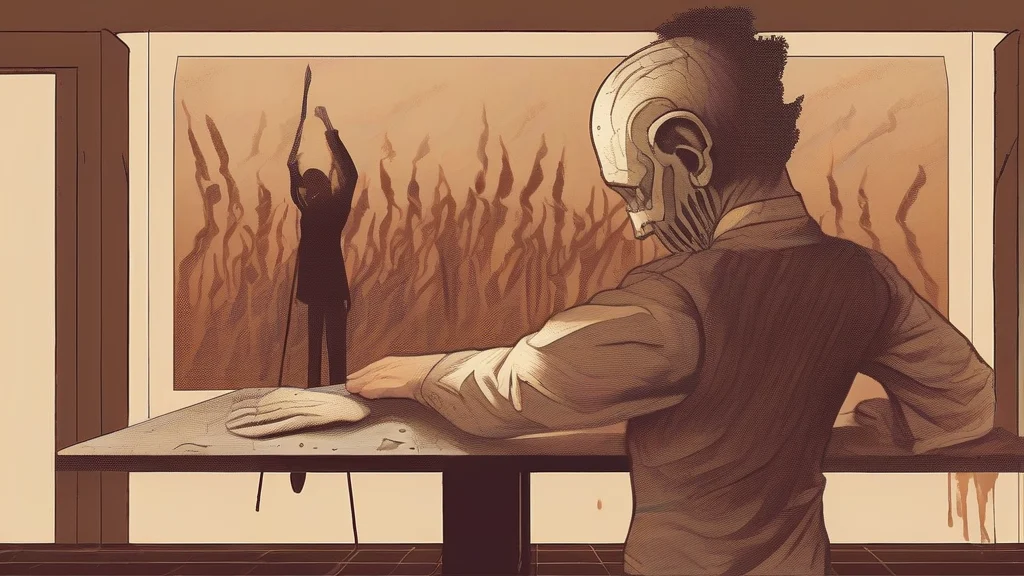
What does decapitated mean?
Decapitated describes something that has had its head removed, whether literally or figuratively. In its literal sense it refers to a person or animal that has been beheaded, appearing most often in historical accounts of executions, forensic reports, or descriptions of damaged statues and monuments. In a figurative sense, widely used in journalism and political analysis, an organisation, army, or movement is said to have been decapitated when its leadership has been eliminated or removed, leaving it without direction. The word derives from the Latin caput, meaning 'head', the same root behind capital, captain, and per capita. Because of its violent literal core, the term carries a strong, sometimes grisly connotation, so writers often prefer it precisely for dramatic effect, while the figurative use remains comparatively neutral and clinical.
Past tense and past participle of decapitate: to have cut off the head of (a person or animal), or to have removed the leadership of (an organisation).
"Revolutionaries decapitated the statue in the town square."
The figurative use with organisations is standard in political and business journalism.
Having had the head cut off, or (of an organisation) deprived of its leader.
"A decapitated marble bust lay among the ruins."
From Latin caput, 'head' — the same root that gives us capital, captain, and per capita.
Reviewed by Deb Chak, Editor. AI-assisted content curated by RJS Tech Solutions LLP.
Etymology of decapitated
Decapitated comes from the verb decapitate, formed from the Latin prefix de- ('away, off') and caput ('head'), via the Late Latin decapitare. The English verb decapitate is attested from the early 17th century, and 'decapitated' serves as its past tense, past participle, and adjectival form. It shares the root caput with a wide family of English words including capital, captain, chapter, and per capita.
Related word forms
How decapitated is actually used
Literal use is typically confined to historical, medical, forensic, or journalistic contexts describing executions or accidents. The figurative sense — an organisation 'decapitated' by losing its leaders — is common in news and political commentary and is somewhat formal in register.
Easily confused with decapitated
Decaffeinated means having had caffeine removed, while decapitated means having had a head (or leader) removed.