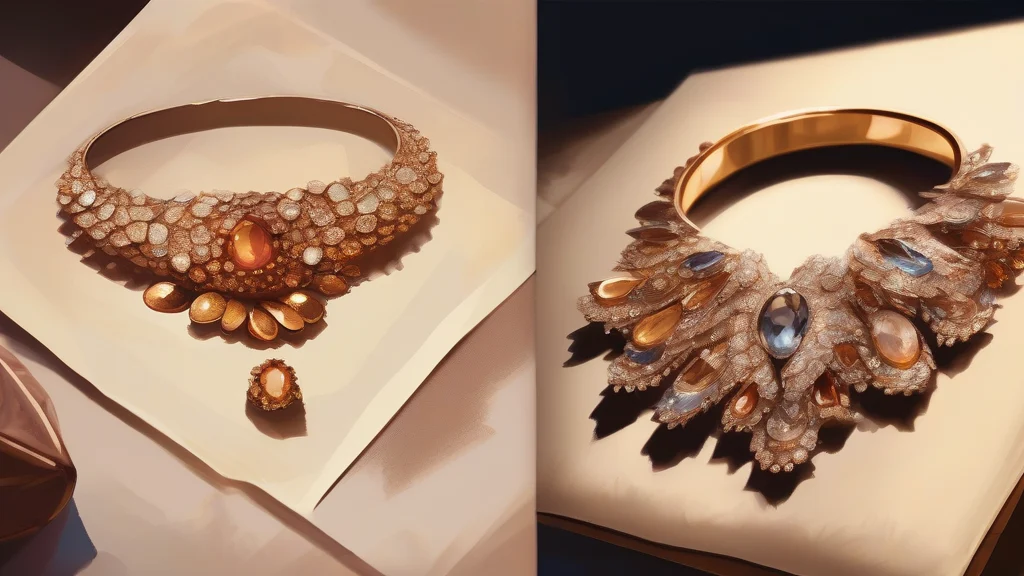
What does bejeweling mean?
Bejeweling is the act of adorning a person or object with jewels, gems, or sparkling ornaments. It functions as the present participle and gerund of the verb 'bejewel', allowing writers to describe decoration in progress ('she was bejeweling the crown') or to treat the activity itself as a noun ('bejeweling was her specialty'). The word also carries a vivid figurative sense: anything that glitters across a surface can be said to bejewel it, as when dew bejewels a spider's web at dawn. Connotations are luxurious, ornate, and celebratory, which makes the word especially at home in fashion writing, historical fiction, and poetic description. American English spells it with a single 'l', while British English prefers 'bejewelling'. Though not part of casual daily vocabulary, it offers a precise, evocative alternative to plainer terms like 'decorating' whenever brilliance and preciousness are the point.
Adorning or decorating with jewels or sparkling ornamentation.
"The artisans were bejeweling the ceremonial headdress for the coronation."
Often used figuratively for natural glittering effects such as dew or frost.
The activity or craft of applying jeweled decoration to something.
"Careful bejeweling requires patience and a steady hand."
Less common than the verbal use; typically found in discussions of crafts or fashion.
Though it sounds purely decorative, 'bejeweling' shares an ancient root with the word 'joy' — both trace back to a Latin term for delight, making a jewel quite literally a little piece of happiness.
Reviewed by Deb Chak, Editor. AI-assisted content curated by RJS Tech Solutions LLP.
Etymology of bejeweling
The verb 'bejewel' combines the prefix 'be-' (used to form verbs meaning 'to cover or furnish with') with 'jewel', which entered English from Old French 'jouel' in the Middle Ages. 'Jouel' itself derives ultimately from Latin 'gaudium', meaning joy, making the jewel etymologically a token of delight — a root it shares with 'joy', 'enjoy', and 'rejoice'. The participial form 'bejeweling' arose naturally once the verb was established, with the doubled-consonant British spelling 'bejewelling' developing alongside it.
Related word forms
How bejeweling is actually used
Literary and somewhat formal in register; more common in descriptive prose than everyday speech. The spelling 'bejewelling' is standard British usage, while 'bejeweling' is preferred in American English.
Easily confused with bejeweling
'Beveling' means cutting or sloping an edge at an angle, while 'bejeweling' means decorating with jewels.