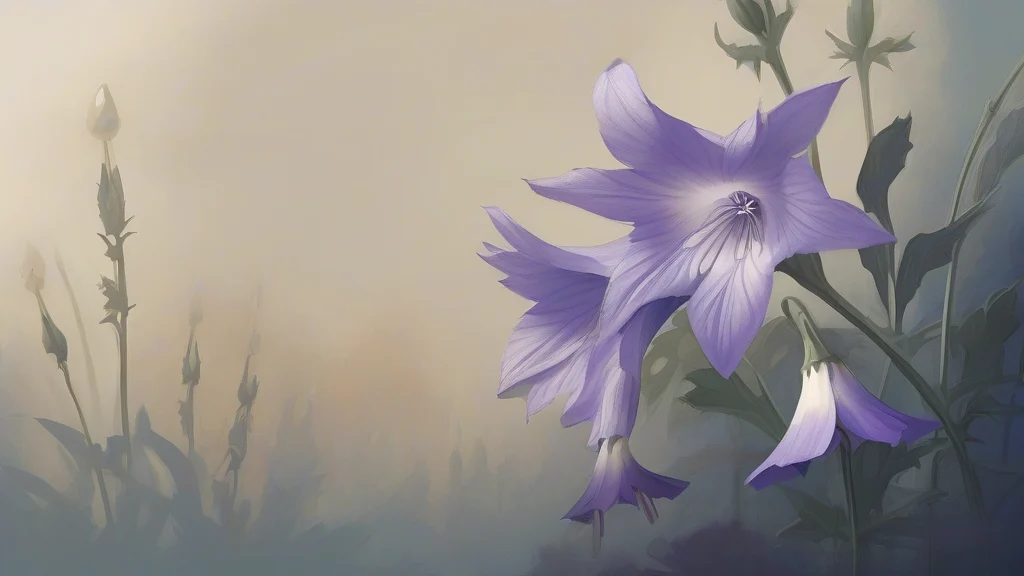
What does bellflower mean?
A bellflower is any herbaceous plant belonging to the genus Campanula, a large group within the family Campanulaceae known for their distinctive bell-shaped blossoms, most often in shades of blue, violet, or white. The genus takes its name from the Latin campanula, meaning 'little bell,' a fitting description of the nodding, cup-like flowers. Bellflowers include well-loved garden species such as Canterbury bells, peach-leaved bellflower, and clustered bellflower, as well as the delicate wildflower known in Britain as the harebell. The word is used chiefly in gardening and botanical contexts, though it can also apply loosely to unrelated plants with similarly shaped blooms. Gardeners prize bellflowers for their long summer flowering and graceful vertical accents, though one species, creeping bellflower, is regarded as a stubborn invasive weed in parts of North America. The term is neutral in register and instantly evocative of cottage gardens and summer meadows.
nounA herbaceous plant of the genus Campanula (family Campanulaceae), bearing bell-shaped flowers, typically in shades of blue, violet, or white; also, any of various other plants with similar bell-shaped blooms.
- Any plant of the genus Campanula, having typically blue, violet, or white bell-shaped flowers.
- More loosely, any of various unrelated plants with bell-shaped flowers.
"Tall spikes of peach-leaved bellflower swayed along the cottage garden border."
"She planted creeping bellflower along the stone path, where its pale blue bells spilled over the edge all summer."
"In medieval monastery gardens, Canterbury bells were prized among the bellflowers for their stately spires of bloom."
Regular plural. Used both for multiple individual plants and for the group collectively.
"Bellflowers self-seed readily, returning each year in widening drifts."
The bellflower's scientific name, Campanula, comes straight from the Latin word for 'little bell' — botanists were simply describing what they saw.
Reviewed by Deb Chak, Editor. AI-assisted content curated by RJS Tech Solutions LLP.
Etymology of bellflower
The word bellflower is a straightforward English compound of 'bell' and 'flower,' formed because the blossoms resemble small bells. It was applied to members of the genus Campanula, whose very name derives from the Late Latin campana ('bell'), itself connected to the region of Campania in Italy, where bronze casting was renowned. The compound is recorded from the early modern period, when European herbalists were cataloguing garden and wild plants under vernacular names. Cognate constructions appear in other European languages, reflecting the same descriptive impulse behind Latin-derived botanical naming.
How bellflower is actually used
Register is neutral to slightly horticultural; the word appears most often in gardening and botanical writing. In British usage, 'harebell' is a common specific name within the group, while North American gardeners more often say 'campanula.' Note that some plants called bellflowers in casual use are invasive weeds (notably Creeping Bellflower in North America), so the word can carry a cautionary note in gardening contexts.
Easily confused with bellflower
A bellwether is the lead sheep of a flock or, figuratively, an indicator of trends, while a bellflower is a flowering plant with bell-shaped blossoms.