
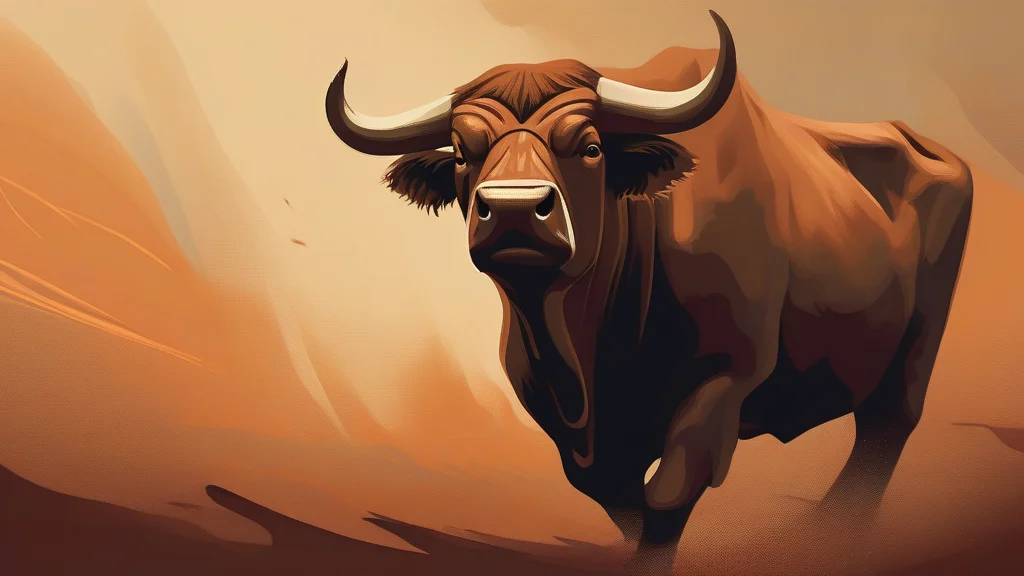
What does bellow mean?
To bellow is to produce a deep, powerful, resonant roar — the kind of sound a bull makes when it bellows in a field, or the way an enraged commander might bellow orders across a battlefield. The word applies both literally to the low, booming cries of large animals, particularly bulls and oxen, and figuratively to human voices raised in anger, command, or exertion. Because of its association with volume, force, and often fury, bellow is a more vivid and charged alternative to ordinary words like shout or yell: it suggests not just loudness but depth and physical power. Writers reach for it when they want a character's voice to feel overwhelming or animalistic. The word traces back through Old English to a Latin root shared with terms of war and aggression, which suits its aggressive tone. It can also function as a noun, naming the roar itself. Anyone describing storms of temper, military discipline, or livestock will find bellow an indispensable word.
To emit a deep, loud roar, as a bull; to shout in a deep, powerful, often angry voice.
"He bellowed with fury when he saw the damage."
Often used with 'at', 'with rage', or direct quotation of shouted speech.
A deep, loud roar or bellowing cry, especially that of a bull or other large animal.
"We heard the bellow of the bull from across the field."
Note: 'bellows' as a separate noun refers to a device for blowing air into a fire, unrelated to the roar of an animal. As a plural of this noun sense, 'bellows' refers to multiple instances of bellowing.
"The bellows of the agitated cattle echoed across the valley."
The word for a bull's roar comes from the same Latin root as 'rebellion' — because that root, 'bellare', means to make war.
Reviewed by Deb Chak, Editor. AI-assisted content curated by RJS Tech Solutions LLP.
Etymology of bellow
Bellow derives from Old English 'bylgan' or related forms meaning to roar, ultimately connected to Latin 'bellare', meaning to make war (from 'bellum', war). This same Latin root gives English such words as bellicose, rebel, and rebellion. The word has been used since Old English times for the roaring of animals, and by extension for loud human shouting.
Related word forms
How bellow is actually used
Bellow carries connotations of anger, power, or raw force — it is stronger and more dramatic than simply shouting. When applied to animals it most commonly describes cattle, especially bulls.
Easily confused with bellow
A billow is a large swelling wave or cloud of smoke; 'billow' (with an i) refers to surging movement, while 'bellow' refers to a loud roar or shout.