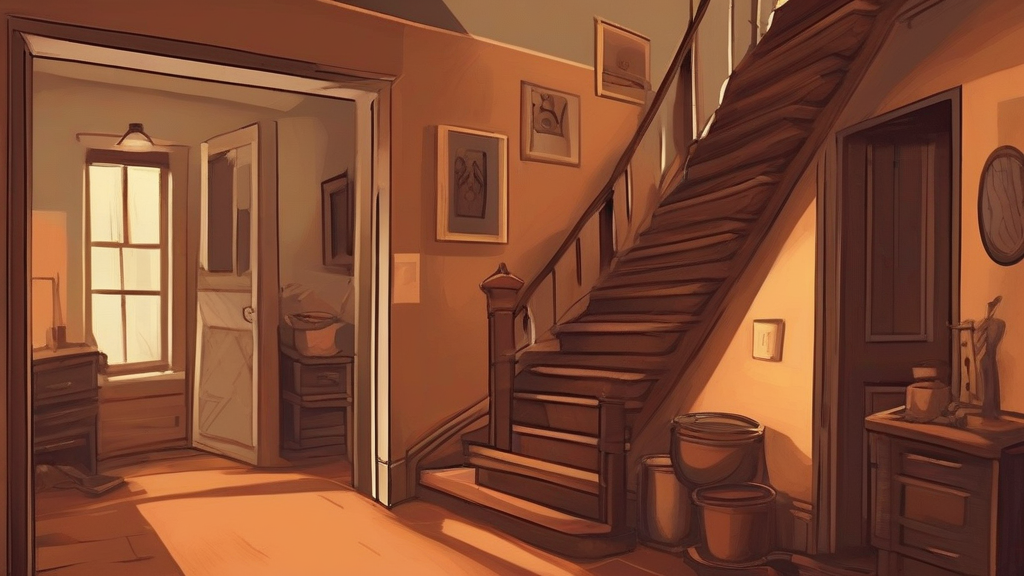
What does belowstairs mean?
"Belowstairs" refers to the lower regions of a large house — most famously the servants' quarters of grand British homes — and can function as an adjective, adverb, or loosely as a noun denoting the servant class itself. In a stately home, the grand rooms occupied by the family were said to be abovestairs, while everything beneath them — kitchens, sculleries, servants' halls, and sleeping quarters — was belowstairs. The word evokes an entire social world: the rigid hierarchy of housekeepers, cooks, footmen, and maids who lived and worked largely out of sight of their employers. Though rooted in this historical context, it remains current in writing about domestic service, period drama, and heritage culture. Its enduring appeal lies in the way it compresses a whole hidden society into a single directional term — simply the space below, yet shorthand for a vanished way of life.
To or in the lower part of a house, especially the servants' quarters.
"The cook summoned the kitchen maid belowstairs before dawn."
Most common in historical or domestic-service contexts.
Situated in or relating to the servants' quarters or lower floor of a large house.
"Her belowstairs duties began at five each morning."
The domestic servants of a large household, regarded collectively.
"All of belowstairs gathered to watch the new valet arrive."
Informal collective use; typically treated as singular.
Before Downton Abbey made it famous, "belowstairs" was how an entire hidden society of servants described their own world — literally everything that happened under the grand floors of the great house.
Reviewed by Deb Chak, Editor. AI-assisted content curated by RJS Tech Solutions LLP.
Etymology of belowstairs
"Belowstairs" combines "below," from Old English roots meaning "lower down" (ultimately related to Old Norse "lágr," meaning low), with "stairs," from Old English "stæger." The compound arose naturally in the vocabulary of large households, where physical position within the house mapped onto social rank. It parallels its counterpart "abovestairs," and both terms became established usage in Britain during the era of formal domestic service.
How belowstairs is actually used
The word carries strong associations with the class system of large British households of the 18th–20th centuries, so it often appears in historical fiction and period drama contexts. When referring to servants collectively it functions informally as a noun, usually treated as singular.
Easily confused with belowstairs
"Belowstairs" is written as one word when used as an adjective or adverb, while "below stairs" is the older two-word phrase meaning the same thing.