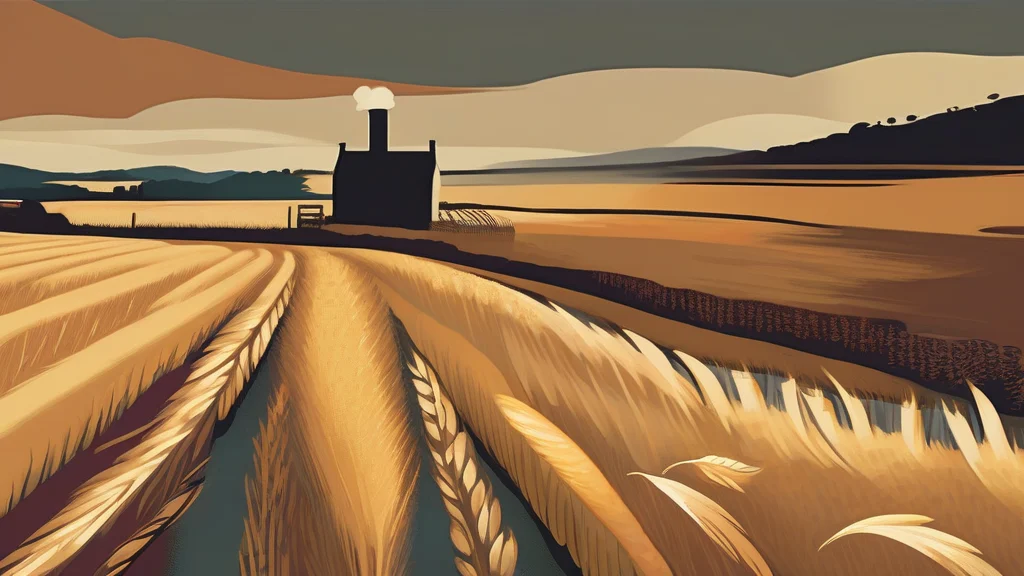
What does bere mean?
Bere is a traditional British word for barley, applied especially to the hardy four-rowed barley long cultivated in northern Scotland and northern England. It survives today mainly as a regional and historical term, familiar from farming communities in Orkney and Shetland, where ancient strains of bere are still grown and milled into bere meal for breads and biscuits such as bannocks. The word comes from Old English bere, meaning barley, and is etymologically related to words like barn, originally a storehouse for this very crop. Because bere sounds exactly like bare and bear, its meaning depends almost entirely on written context. For most modern readers it appears chiefly in agricultural writing, place names, and discussions of traditional foodways rather than everyday conversation.
nounAn old and regional name for barley, especially a hardy four-rowed barley traditionally grown in northern Scotland and northern England.
- Barley, especially the hardy four-rowed variety long grown in northern Scotland and northern England.
"The crofters sowed bere on the thin coastal soil where little else would ripen."
"The crofters sowed bere on the thin coastal soil where little else would ripen."
"Traditional bannocks were baked with flour ground from locally grown bere."
Bere normally functions as a mass noun referring to the grain collectively, so it takes no plural; a rare plural 'beres' would refer only to distinct varieties.
"The field was thick with ripe bere ready for harvest."
Bere isn't just any barley — Orkney farmers have grown this ancient strain continuously for thousands of years, making it one of the oldest cereals still cultivated in Britain.
Reviewed by Deb Chak, Editor. AI-assisted content curated by RJS Tech Solutions LLP.
Etymology of bere
Bere derives from the Old English bere, meaning barley, which was in common use throughout the medieval period before gradually giving way to the compound form barley. The same root lies behind barn, originally bere-ærn, literally a 'barley house' or granary. It is also connected by scholars to the Germanic word underlying barley and, more distantly, has been linked to the Latin far, meaning spelt or coarse grain, though that wider connection is less certain. In Scotland and northern England the word persisted long after it faded elsewhere, remaining the standard local term for the four-rowed barley of the region.
How bere is actually used
Bere is a chiefly British term, now largely confined to Scots and Northern English usage, particularly in agricultural and historical contexts such as Orkney and Shetland farming. It functions as a mass noun and sounds identical to bare and bear, so context does the work in speech.
Easily confused with bere
Bare means uncovered or plain, whereas bere is a noun denoting barley.
Beer is the fermented drink; bere is the barley grain that can be used to brew it.
Bear is the animal or the verb meaning to carry; bere refers to a type of barley.