
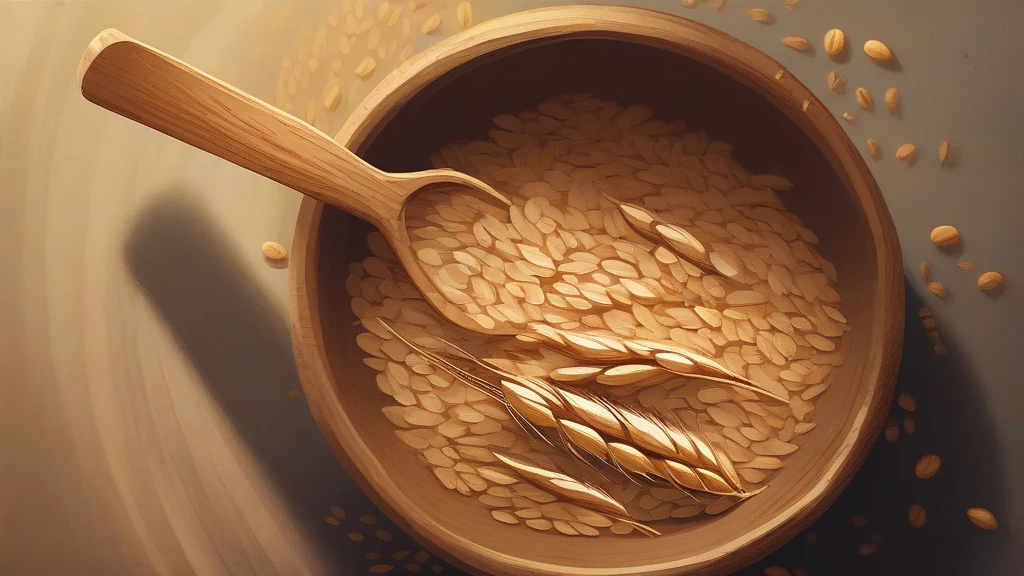
What does grain mean?
Grain most commonly refers to the edible seeds harvested from cereal plants such as wheat, barley, oats, rice, and maize. It can also mean a tiny particle, the visible texture or fibrous pattern of wood or another material, and a minute unit of weight. Figuratively, expressions such as “a grain of truth” use the word for a very small amount of something. As a verb, grain means to make or become granular; in informal North American usage, it can also mean to irritate or annoy. The word is especially important in agriculture, food production, cooking, materials science, and photography. Its long history and numerous related English words reflect how closely grain has been associated with seeds, small particles, texture, and the natural structure of the world.
Grain is an edible seed, especially a cereal seed, and by extension a small particle or the natural texture or pattern of a material. It can also refer to a tiny unit of weight or, figuratively, a very small amount.
"The miller tested the grain for moisture before storing it."
The singular can refer to one seed or particle as well as an uncountable mass, depending on context. Abstract figurative senses commonly use expressions such as “a grain of truth” or “a grain of evidence.”
As a verb, grain means to make or become granular or to develop a visible granular texture. Informally, especially in North American English, it can also mean to irritate or annoy someone.
"The old printer grained the surface before applying the finish."
“Grains” is the standard plural when referring to individual seeds, particles, or small units; the collective singular “grain” is commonly used for the harvested cereal crop.
"The grains of rice were still firm at the center."
The word “grain” is a linguistic seed: it grows from Latin granum into French and English—and into granary, granule, and granola.
Reviewed by Deb Chak, Editor. AI-assisted content curated by RJS Tech Solutions LLP.
Where does grain come from?
English “grain” comes through Old French grain from Latin granum, meaning “seed” or “grain.” The Latin word is also the source of related forms such as granary, granule, and granular, while granola entered English from Spanish and ultimately draws on the same Latin root. Across these languages, the word has remained associated not only with cereal seeds but also with small particles and the natural texture of materials.
Related word forms
How grain is actually used
The word is formal or neutral in most of its established senses. In informal North American English, the verb “grain” can mean to irritate someone, while “graining” can describe the process of forming a granular texture.