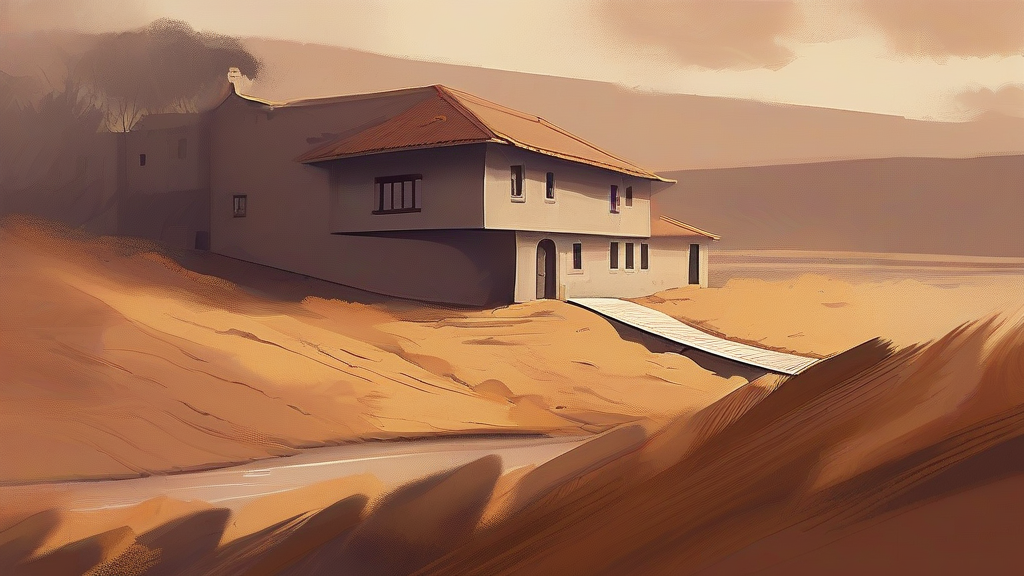
What does berme mean?
A berme is a narrow, level strip of ground that runs along the base of something larger — most classically, the inner foot of a fortified rampart, where its purpose was to catch earth and debris dislodged from the wall above and to provide footing for defenders. The word also appears in civil engineering and landscaping, describing similar ledges beside canals, roads, ditches, and embankments. Largely a technical and historical term, 'berme' is now encountered mainly in discussions of military architecture, fortification design, and older engineering works. In contemporary English the spelling 'berm' is far more common, though the two forms denote the same thing. Knowing 'berme' is useful for readers of military history, siege accounts, and heritage conservation documents, where precise terminology for defensive earthworks still matters.
nounA narrow ledge or strip of land, especially one running along the base of a rampart in a fortification or alongside a canal, road, or embankment.
- A narrow horizontal ledge or terrace along the inner base of a fortification rampart, designed to catch falling earth and debris.
- A narrow strip or bank of ground beside a canal, road, ditch, or embankment.
"The surveyor walked the berme at the foot of the old city wall, noting where erosion had narrowed it."
"Rain had washed soil down the scarp until the berme beneath the rampart was barely a hand's width wide."
"Maintenance crews cleared weeds from the berme running alongside the canal towpath."
Regular plural; used when referring to multiple ledges, such as those at successive tiers of a bastioned fortress.
"The fortress's tiered defences were linked by a series of grass-grown bermes."
Before it named a roadside strip, a berme was the soldier's walkway — the flat shelf built into fortress walls to catch debris falling from the parapet above.
Reviewed by Deb Chak, Editor. AI-assisted content curated by RJS Tech Solutions LLP.
Etymology of berme
The word entered English in the seventeenth century from French 'berme', which itself came from Spanish 'berma', a term used in Spanish military engineering for the ledge at the base of a rampart. Its further origin is uncertain, though some sources connect it to Arabic. The common modern spelling 'berm' arose as a phonetic variant of the same word.
Related word forms
How berme is actually used
Largely technical and historical today: 'berme' survives chiefly in military architecture (fortifications) and civil engineering contexts. In everyday usage, the spelling 'berm' has largely displaced it.
Easily confused with berme
'Berm' is simply the more common modern spelling and pronunciation-variant of 'berme'; both refer to the same kind of narrow earthen ledge.