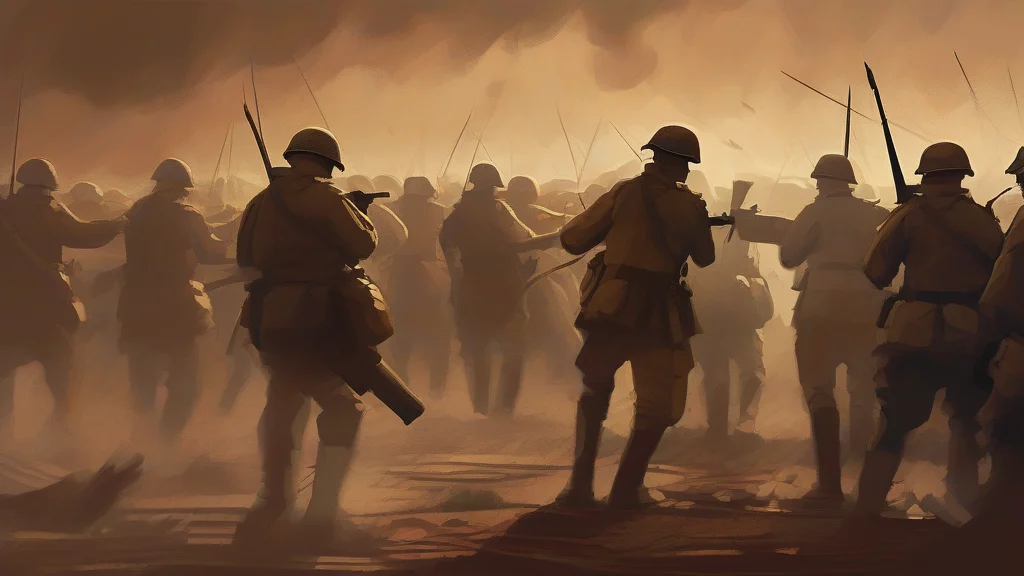
What does besieging mean?
Besieging is the act of encircling a place — historically a fortified town or castle — with armed forces in order to cut off supplies and compel surrender. In modern English the word has expanded well beyond warfare: journalists describe fans besieging a celebrity's hotel, customers besieging a shop on opening day, or officials being besieged with complaints. Whether literal or figurative, the term always carries the sense of sustained pressure applied from all sides, often over time. It derives from 'besiege', which entered Middle English through Old Dutch and Anglo-Norman French, ultimately tracing back to the Latin 'sedere', 'to sit' — a reminder that an old siege was literally an army sitting down outside the walls until resistance collapsed.
Present participle of 'besiege': to surround a place with armed forces in order to capture it, or to crowd and press persistently upon a person or place.
"The villagers spent weeks besieging the mayor with petitions."
Used both literally (military sieges) and figuratively (overwhelming attention or demands).
The action of laying siege to a place; an instance of besieging.
"The prolonged besieging of the city left its population starving."
Less common than the verbal participle; typically found in formal or historical writing.
The word 'siege' traces back to the Latin 'sedere', meaning 'to sit' — so to besiege a city is, etymologically, to sit down outside its walls until it gives up.
Reviewed by Deb Chak, Editor. AI-assisted content curated by RJS Tech Solutions LLP.
Etymology of besieging
Besieging comes from the verb 'besiege', which entered Middle English around the late medieval period from Anglo-Norman French 'siéger' (to sit), reinforced by Middle Dutch 'besien'. Both trace back to the Latin 'sedere', 'to sit'. The underlying image is literal: an attacking army sits down outside a city's walls and waits. Cognates sharing the Latin root include 'session', 'sedentary', and 'assiduous'.
Related word forms
How besieging is actually used
As a verb form, 'besieging' is neutral-to-formal in register and works in both literal military contexts and figurative ones involving pressure or crowding. The figurative sense is common in journalism. The noun use ('the besieging of the city') is less frequent than the verbal participle.
Easily confused with besieging
'Besetting' describes something that habitually plagues or afflicts someone (as in a 'besetting sin'), while 'besieging' refers to actively surrounding and pressing upon a place or person.