What does beton mean?
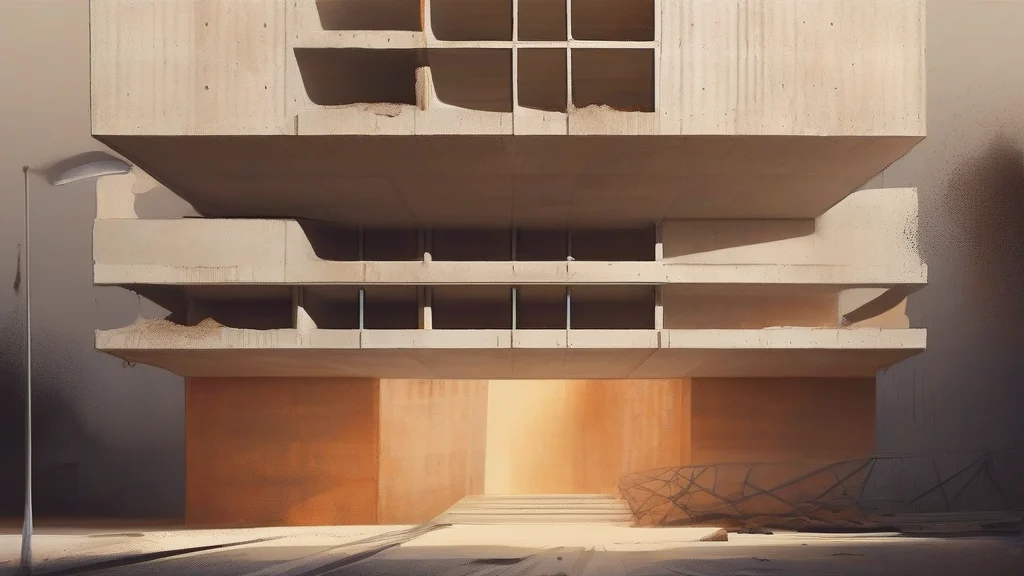
Beton is the English adoption of the French word for concrete, the composite building material made by mixing cement with water and aggregate such as sand and gravel. While everyday English simply says 'concrete', the word beton persists in technical, engineering, and architectural contexts, particularly on the European continent, where it remains the standard term. Its most visible foothold in English is the phrase béton brut — literally 'raw concrete' — which architects use to describe surfaces left unfinished, with the marks of the formwork still showing. This phrase gave rise to the name of the Brutalist movement of the mid-twentieth century, whose monumental buildings in exposed concrete define campuses and civic centres worldwide. Writers reach for beton when they want precision or a deliberate nod to that tradition, lending the word a slightly specialist, design-literate air rather than everyday currency.
nounA mass or structure of concrete, especially as used in building and civil engineering. In English the word survives chiefly in the architectural term 'béton brut', meaning raw or unfinished concrete left exposed.
- Concrete as a building material, especially when discussed in technical, engineering, or continental European contexts.
- Exposed or unfinished concrete as an aesthetic material in architecture (chiefly in the phrase 'béton brut').
"The architect specified board-marked beton for the retaining walls so the timber grain would remain visible."
"The bridge's piers were cast in reinforced beton to withstand decades of river traffic."
"Le Corbusier's Unité d'Habitation celebrated béton brut, leaving the shuttering marks untouched."
Rarely pluralized; as a mass-material noun it usually takes no plural. A plural may appear when referring to different types or mixes of concrete.
"The laboratory tested several high-strength betons before settling on the final mix."
Brutalism isn't named for being brutal — its name comes straight from the French phrase béton brut, 'raw concrete'.
Reviewed by Deb Chak, Editor. AI-assisted content curated by RJS Tech Solutions LLP.
Etymology of beton
Beton was borrowed into English from French béton, meaning 'concrete', a word long established in French technical vocabulary. The French term itself has been linked by some etymologists to Latin bitumen, though its deeper origin is treated as uncertain, and English usage has always remained largely confined to specialist architectural and engineering writing. Its cultural prominence grew through twentieth-century modernism, when the Swiss-French architect Le Corbusier championed béton brut, the raw, unfinished concrete that later lent the Brutalist movement its name.
How beton is actually used
In ordinary English speech, 'concrete' is almost always preferred; 'beton' sounds technical or deliberately Continental. It is most at home in architectural writing about modernist and Brutalist buildings, where the French spelling with an acute accent (béton) is often retained.
Easily confused with beton
A baton is a short stick carried by a conductor, police officer, or relay runner, whereas beton refers to concrete as a building material.
Cement is the binding powder that, mixed with water and aggregate, hardens into beton (concrete); the two materials are often conflated in everyday speech.