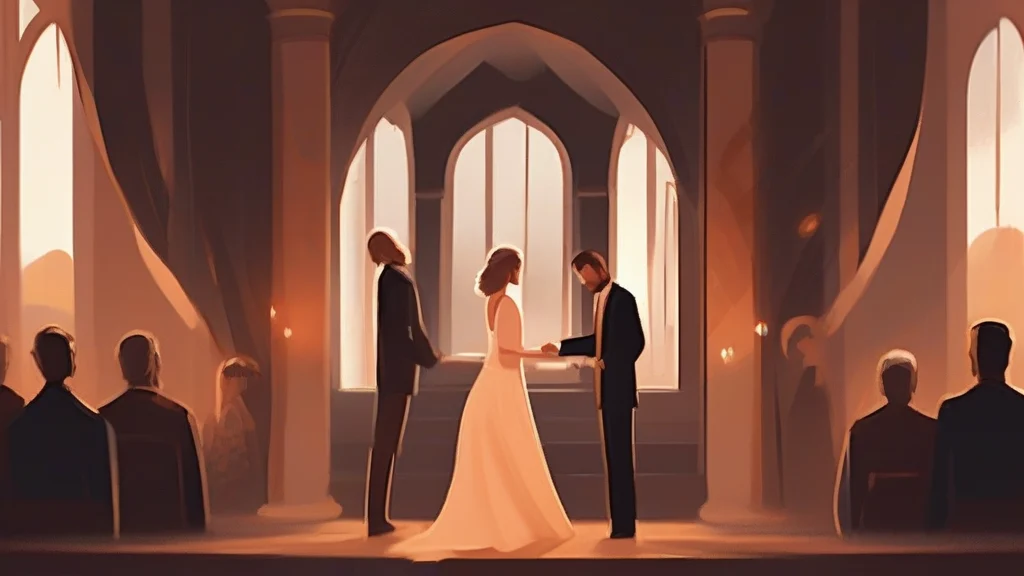
What does betrothal mean?
Betrothal is a noun meaning a formal engagement — a mutual promise between two people, or more often between their families, that they will marry. It can refer either to the state of being promised in marriage or to the act or ceremony by which such a promise is made. The word carries a distinctly formal, even archaic tone: while modern speakers almost always say 'engagement,' betrothal survives readily in literature, history, and discussions of traditional societies, where it evokes arranged matches, dowries, and family alliances rather than romantic courtship. It derives from the verb 'betroth,' formed in Middle English from 'be-' plus 'troth,' an old word for fidelity or pledged faith that shares its origin with 'truth.' A betrothal may be solemnized publicly, as among royalty or in religious communities, and historically breaking one carried serious social consequences. Today it most often appears in writing about past eras, other cultures, or deliberately ceremonial occasions.
nounThe formal act of promising to marry someone; an engagement to be married, especially one arranged or announced in a traditional or ceremonial manner.
- A formal engagement or mutual promise to marry.
- The act or ceremony of becoming engaged to be married.
"Their betrothal was celebrated with a formal dinner attended by both families."
"The couple's betrothal was announced in the local paper before their wedding the following spring."
"In many historical accounts, a betrothal carried nearly as much legal and social weight as marriage itself."
The plural typically appears when discussing multiple engagements across families, cultures, or historical periods rather than several engagements of one person.
"Medieval chronicles record numerous betrothals arranged between noble houses to secure political alliances."
Every time you say 'truth', you're speaking the same ancient word that hides inside 'betrothal' — the promise to wed was once literally the promise to be 'true'.
Reviewed by Deb Chak, Editor. AI-assisted content curated by RJS Tech Solutions LLP.
Etymology of betrothal
Betrothal comes from the verb 'betroth,' formed in Middle English from the prefix 'be-' combined with 'troth,' an Old English-derived word meaning fidelity or pledged faith, which itself shares its Germanic root with 'truth.' The sense developed naturally: to betroth someone was to pledge them faithfully in marriage. The noun 'betrothal' arose later as a derivative of the verb, following the common pattern of '-al' nouns of action. Cognates within English include 'troth' and 'truth,' both preserving the original idea of trustworthiness at the heart of a marriage promise.
Related word forms
How betrothal is actually used
Betrothal is a formal, somewhat old-fashioned word; 'engagement' is the ordinary modern term in everyday speech. It often appears in historical, literary, or anthropological contexts describing arranged marriages, royal unions, or traditional ceremonies where families formally agree to a match.
Easily confused with betrothal
Betrayal means the act of being disloyal or treacherous toward someone, while betrothal refers only to a promise or agreement to marry.