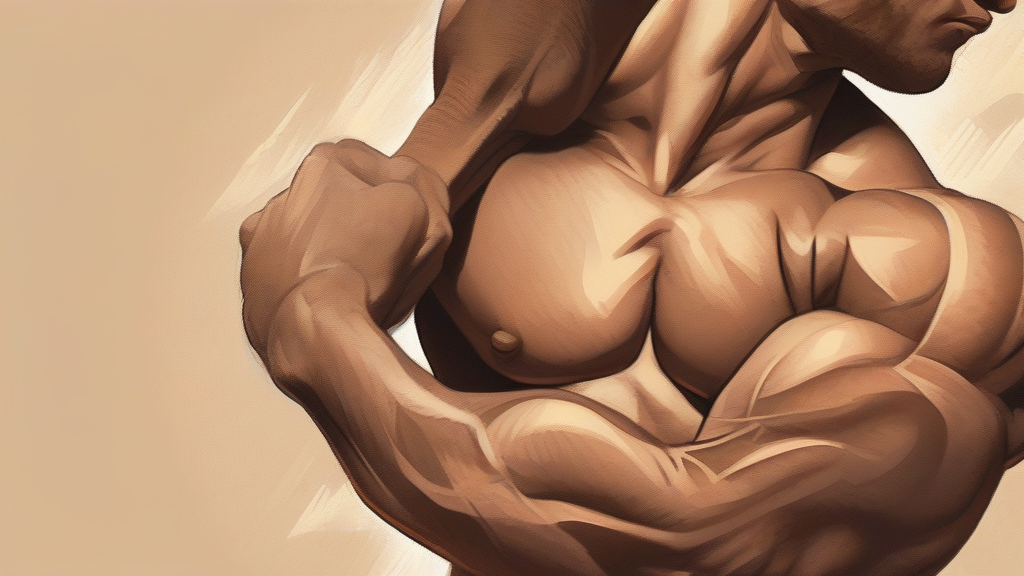
What does bicep mean?
A bicep is the prominent muscle running along the front of the upper arm, responsible for bending the elbow and rotating the forearm so the palm turns upward. The word is a shortened, informal form of the anatomical term "biceps," whose full name, biceps brachii, means "two-headed muscle of the arm" in Latin, referring to its two points of attachment near the shoulder. In everyday speech, people often say "a bicep" when referring to one of these muscles and "biceps" for the pair or for several, though traditionally "biceps" served as both singular and plural. The word carries strong associations with physical fitness, strength training, and bodybuilding — exercises such as bicep curls are named after it, and a well-developed bicep has long been a popular symbol of muscularity. It appears frequently in sports, medicine, and casual conversation about exercise and appearance.
nounA bicep is a large muscle at the front of the upper arm that flexes the elbow and rotates the forearm; the term usually refers to one of the biceps brachii muscles.
- The large muscle at the front of the upper arm that bends the elbow (short for biceps brachii).
- Informally, muscular strength or arm development, as in showing off one's biceps.
"He felt his bicep tighten as he lifted the heavy crate."
"The physiotherapist tested the strength of her injured bicep."
"After months of training, he finally had a bicep to show off in a T-shirt."
Traditionally, "biceps" serves as both singular and plural. In informal usage, "bicep" is used for one muscle and "biceps" (or occasionally "bicepses") for more than one.
"Both of his biceps were sore after the workout."
Strictly speaking, you have two biceps in each arm — but almost everyone says "bicep" anyway, a word invented by chopping the ending off "biceps."
Reviewed by Deb Chak, Editor. AI-assisted content curated by RJS Tech Solutions LLP.
Etymology of bicep
The word derives from Latin "biceps," meaning "two-headed," formed from "bis" (twice) plus "-ceps" (headed), a combining form related to "caput" (head). The anatomical name biceps brachii was adopted into English from New Latin in the early modern period. Because "biceps" ends in what looks like an English plural -s, speakers gradually reinterpreted it as plural, producing the back-formation "bicep" for a single muscle; this newer singular is now widespread in general usage. Cognates sharing the same Latin roots include triceps and quadriceps, which describe muscles with three and four heads respectively.
Related word forms
How bicep is actually used
"Bicep" is an informal back-formation from "biceps," which was originally the singular form despite looking plural. In anatomy, medicine, and formal writing, "biceps" is still standard for both singular and plural, but "bicep" and "biceps" are both common in everyday fitness contexts. The adjective form is "bicipital."
Easily confused with bicep
"Biceps" is the traditional anatomical and singular form, while "bicep" arose by back-formation from its plural-like ending; both are widely used, but "biceps" remains preferred in formal medical writing.