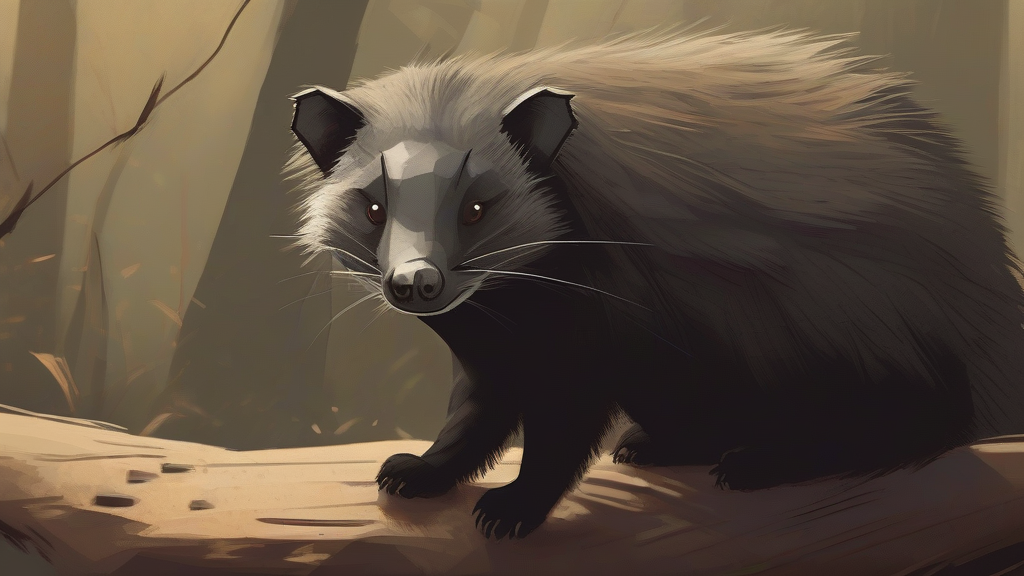
What does binturong mean?
The binturong (Arctictis binturong) is a nocturnal mammal inhabiting the rainforests of South and Southeast Asia, often called the bearcat for its heavyset body and somewhat bear-like face. Despite the nickname, it belongs to the family Viverridae, making it a relative of civets and genets rather than of bears or cats. It is best known for its fully prehensile tail — unusual among carnivorous mammals — which it uses as an anchor while climbing through the canopy in search of fruit, small animals, and leaves. The species is also famous for the distinctive popcorn-like scent produced by its musk glands. The English word comes from Malay, entering European usage through colonial-era naturalists. Today the term occurs chiefly in zoology, conservation writing, and wildlife documentaries, and the animal itself is classified as vulnerable owing to habitat loss and hunting.
nounA large, tree-dwelling viverrid mammal of Southeast Asian forests (Arctictis binturong), with shaggy black fur, a long prehensile tail, and scent glands that produce an odor reminiscent of popcorn.
- The mammal Arctictis binturong, also known as the bearcat, native to South and Southeast Asia.
"The zoo's new enclosure gives visitors a rare chance to watch the binturong move hand over hand through the canopy using its prehensile tail."
"A binturong spent the afternoon draped over a branch, its tail curled around the wood like a fifth limb."
"Because binturongs are largely frugivorous, they play an important role in dispersing strangler fig seeds through the forest."
Regular plural; used when referring to multiple individuals, e.g. in population surveys or zoo collections.
"Camera traps recorded three binturongs moving through the reserve over a single night."
The binturong smells like hot buttered popcorn — and no one is entirely sure why.
Reviewed by Deb Chak, Editor. AI-assisted content curated by RJS Tech Solutions LLP.
Etymology of binturong
The word 'binturong' was borrowed from Malay, where it names the same animal, and entered English through the writings of European naturalists describing the fauna of the East Indies. It belongs to the group of Malay loanwords absorbed into English during the colonial period, alongside terms such as 'amok' and 'sarong'. The animal itself was formally described under the scientific name Arctictis binturong, and its popular alternative name, bearcat, arose from superficial resemblance to both animals despite its true kinship with civets.
How binturong is actually used
The word appears mainly in zoological, conservation, and wildlife-documentary contexts rather than everyday speech; 'bearcat' is an informal alternative name but can be ambiguous, as it has also referred to other animals.
Easily confused with binturong
A civet is any of various catlike viverrids, while the binturong is one specific species within that same family, distinguished by its prehensile tail and stocky build.