What does birk mean?
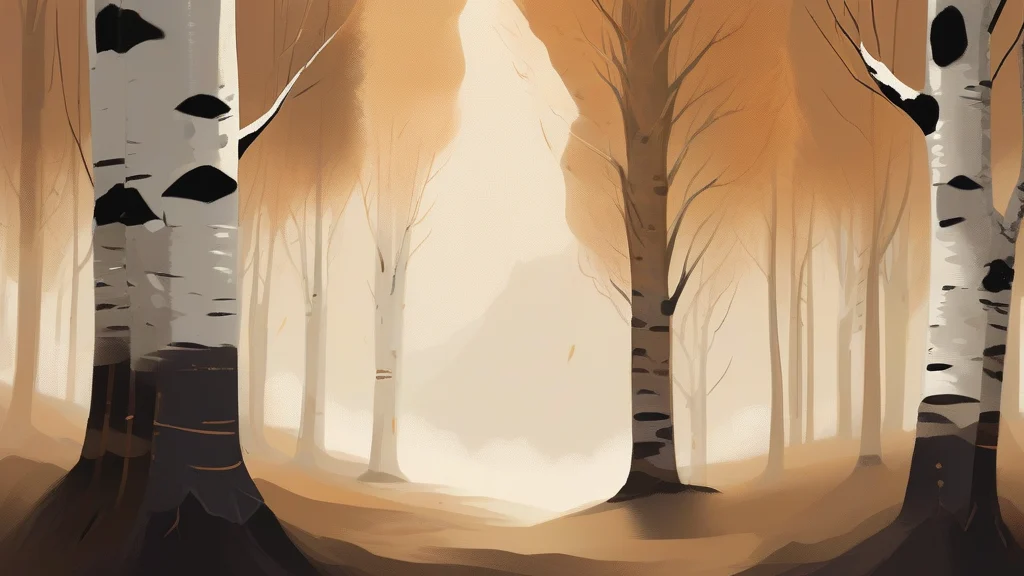
Birk is the Scots and northern English dialect word for the birch tree, a familiar slender hardwood known for its pale bark and delicate foliage. The term functions as both a noun for the tree itself and, by extension, for its wood. Though standard English has adopted 'birch' as the common form, birk survives vigorously in Scottish speech, folk song, and literature — most famously in the poetry of Robert Burns, whose verses celebrate the 'bonnie birk' of the countryside. Because it belongs to a regional and literary register, birk carries a distinctly rustic, traditional flavour; encountering it usually signals Scots heritage or poetic intent. For readers of Burns, Scott, or border ballads, recognising birk is essential to appreciating descriptions of the northern landscape. It is a small word that opens a window onto the older vocabulary of Britain's North.
nounA birch tree; the wood of the birch. A chiefly Scots and northern English dialectal variant of 'birch'.
- A birch tree (Scots and northern English dialect).
- Birch wood or timber.
"The glen was silvered with birk and rowan."
"The path wound through stands of slender birk along the riverbank."
"He carved the ladle from seasoned birk gathered in the Highlands."
The regular plural is used when referring to individual birch trees, especially in Scots poetry and dialect writing.
"The hillside was scattered with young birks after the clear-felling."
Burns sang of the 'bonnie birk' long before standard English settled on birch — this little word is a living fossil of older Scots.
Reviewed by Deb Chak, Editor. AI-assisted content curated by RJS Tech Solutions LLP.
Etymology of birk
Birk derives from the same Germanic root as the standard English word birch, tracing back to Old Norse 'björk', which influenced the northern forms of the word in Britain. It is thus closely related to German 'Birke' and Dutch 'berk', all descending from a Proto-Germanic term for the birch tree. The form with the vowel now heard in Scots took hold in Scotland and northern England while southern varieties developed toward modern 'birch'. Birk has been attested in Scots poetry since at least the Middle Scots period and remains a recognised feature of the dialect.
How birk is actually used
Birk is regional and literary rather than part of everyday modern standard English. It appears most often in Scottish poetry, folk song, and dialect writing, where it carries a traditional, rustic connotation. Outside Scotland and northern England it may strike readers as archaic or unfamiliar.
Easily confused with birk
Birch is the standard modern English form of the word for the tree, while birk is an older Scots and northern dialectal variant of the same word.
Burk is chiefly a surname or an obsolete spelling of 'burke' (to suppress quietly), unrelated to the birk/birch tree.