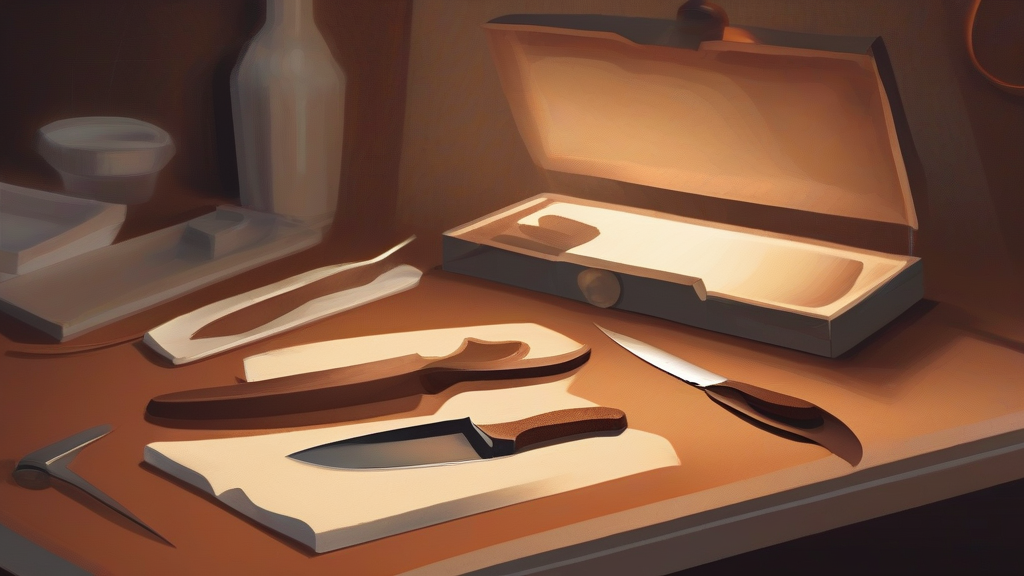
What does bistoury mean?
A bistoury is a long, slender surgical knife designed for making precise incisions, most classically for opening abscesses or draining fluid collections. Its blade may be straight or curved along its edge, and its narrow profile distinguishes it from the broader blades of a standard scalpel. The word belongs chiefly to the vocabulary of surgery, appearing in operative manuals, historical medical texts, and catalogues of antique instruments rather than in everyday speech. Bistouries were staples of the surgeon's case through the eighteenth and nineteenth centuries, and references to them lend writing a distinctly clinical or period flavour. The plural is bistouries. For readers of medical history or fiction set before modern surgical instrumentation, the word is a useful marker of authentic detail, evoking an era when even minor procedures depended on the surgeon's steady hand and a well-honed blade.
nounA long, narrow surgical knife, typically with a straight or curved blade, used for opening abscesses and making incisions in minor operations.
- A long, narrow surgical knife used for incising tissue, especially for opening abscesses.
"The surgeon selected a fine bistoury from the instrument tray before beginning the incision."
"The physician heated the bistoury carefully before lancing the abscess."
"Antique medical kits often contained several bistouries of varying curvature."
Regular plural formed with -ies; standard in both British and American English.
"The display case held bistouries from three different centuries."
This elegant little blade once opened abscesses on Victorian operating tables — and its name may trace back to the Italian city of Pistoia, where such knives were supposedly made.
Reviewed by Deb Chak, Editor. AI-assisted content curated by RJS Tech Solutions LLP.
Etymology of bistoury
The English word 'bistoury' was borrowed in the late sixteenth or early seventeenth century from French 'bistouri', meaning a small surgical knife. The ultimate origin of the French term is uncertain, though one widely repeated account derives it from 'couteau de Pistoie', a knife associated with the Italian city of Pistoia. It entered English alongside other loanwords describing surgical instruments.
Related word forms
How bistoury is actually used
A technical term confined almost entirely to medical, historical, and antique-instrument contexts; rarely encountered outside surgical literature and historical accounts of medicine.
Easily confused with bistoury
A bistro is a small restaurant, while a bistoury is a slender surgical knife; they share letters but nothing else.