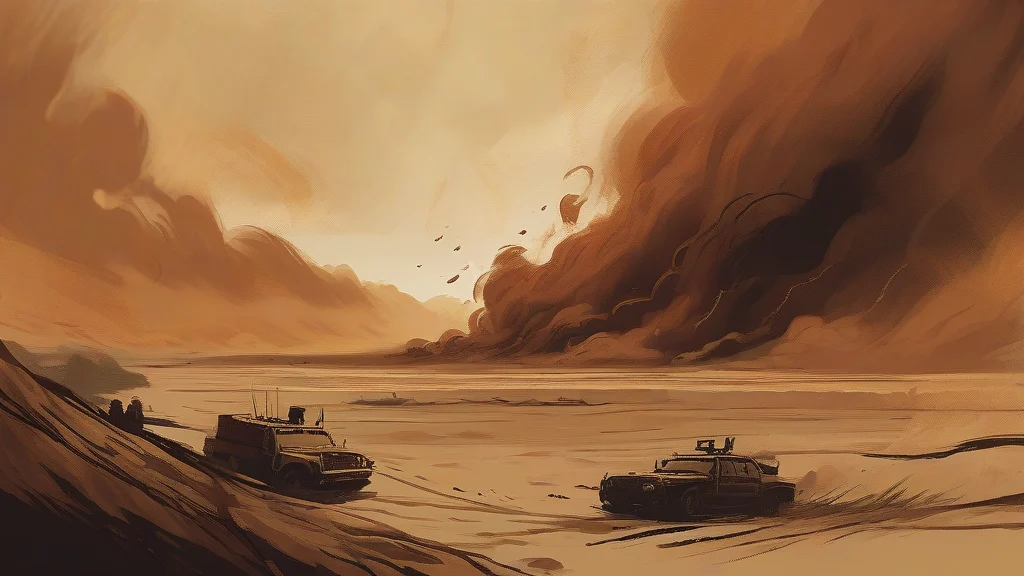
What does fury mean?
Fury denotes anger at its most intense and unbridled — a raging, often uncontrollable emotion that goes well beyond ordinary irritation or indignation. The word can describe a person's explosive wrath, as when someone flies into a fury over an injustice, or a more impersonal violence and ferocity, as in 'the fury of the storm'. In classical mythology, the Furies were fearsome goddesses who avenged grave crimes such as murder and betrayal, giving the word an ancient association with retribution. Strongly negative in connotation, fury appears frequently in literature, journalism, and everyday speech whenever emotions run hot or forces turn violent. Its dramatic weight makes it a useful word for conveying extremity: where 'anger' suggests feeling, 'fury' suggests fire unleashed.
nounFury is intense, unrestrained anger or rage; it also denotes a state of violent, frenzied activity or ferocity.
- Intense, wild anger or rage.
- Violent, frantic, or ferocious energy or force (as of a storm or struggle).
- In classical mythology, one of the avenging spirits (the Erinyes/Furies).
"The villagers' fury at the decision was impossible to contain."
"She flew into a fury when she discovered the contract had been altered."
"The fury of the hurricane flattened entire neighbourhoods overnight."
The plural 'furies' typically refers either to multiple instances of intense rage or, classically, to the group of avenging deities known collectively as the Furies.
"In Greek mythology, the Furies pursued wrongdoers without rest."
The Furies of Greek myth were goddesses of vengeance so feared that people called them 'the kindly ones' — a euphemism to avoid attracting their wrath.
Reviewed by Deb Chak, Editor. AI-assisted content curated by RJS Tech Solutions LLP.
Etymology of fury
Fury derives from the Latin 'furere', meaning 'to rage' or 'be mad', via the related Latin noun 'furor'. It entered English in the medieval period through Old French 'furie', which itself transmitted the Latin root. The same Latin lineage gives English the adjective 'furious' and the noun 'furor', making these close siblings rather than coincidental lookalikes. The mythological Furies of Greek and Roman tradition reinforced the word's association with vengeful, relentless anger.
Related word forms
How fury is actually used
Fury implies anger at its most extreme — beyond mere irritation or anger. It carries strongly negative connotations and is often used dramatically in literature and journalism, both for human emotion and for destructive natural forces (e.g., 'the fury of the storm').
Easily confused with fury
'Furor' is a related but distinct noun denoting a general outburst of public excitement or rage, whereas 'fury' denotes intense personal anger or violent intensity.