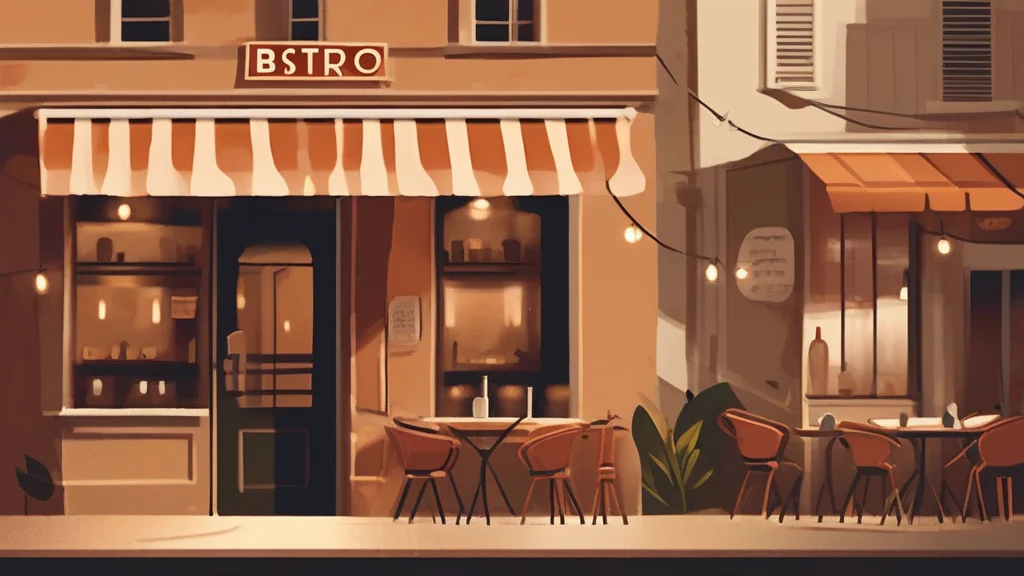
What does bistro mean?
A bistro is a small, informal restaurant that serves simple, well-made food at moderate prices, often alongside wine or coffee. The word comes from French, where it originally referred to the modest neighborhood eating houses of Paris—places known for hearty classics rather than elaborate haute cuisine. In English, 'bistro' has broadened slightly to describe any cozy, unpretentious eatery with a similar spirit, whether or not it serves French food. The term carries distinctly warm connotations: it evokes candlelit tables, chalkboard menus, and relaxed conversation rather than stiff formality or expense. Common phrases include 'bistro table' and 'bistro chair,' which refer to the small round tables and woven-seat chairs typical of these cafés. A popular legend claims the word derives from Russian soldiers shouting 'bystro!' ('quickly!') at Parisian restaurateurs after Napoleon's defeat, though most linguists consider this story dubious. Whatever its true origin, 'bistro' remains a beloved shorthand for casual, characterful dining.
nounA small, informal restaurant serving simple, hearty food and drinks, typically one modeled on the modest Parisian establishments of the same name.
- A small, casual restaurant serving moderately priced, simple meals and wine
- (loosely) a small bar or tavern, especially one associated with such an establishment
"We stopped for dinner at a cozy little bistro off the main square."
"The corner bistro serves the best onion soup this side of the Seine."
"They lingered over espresso at a sidewalk bistro, watching the evening crowd go by."
Regular English plural; occasionally the French-style spelling 'bistrots' appears, chiefly in British English or on menus.
"Paris is full of family-run bistros that have served the same recipes for generations."
Legend says the first bistros got their name because impatient Russian soldiers shouted 'bystro!'—'faster!'—at Parisian café owners after the fall of Napoleon; linguists doubt the story, but it stuck anyway.
Reviewed by Deb Chak, Editor. AI-assisted content curated by RJS Tech Solutions LLP.
Etymology of bistro
Bistro entered English from French in the late nineteenth century, borrowed from the French bistrot, which denoted a small Parisian wine shop or tavern serving simple meals. The deeper origin of the French word itself is disputed: the most famous theory links it to Russian bystro ('quickly'), supposedly shouted by occupying soldiers demanding faster service around 1815, but most etymologists regard this as folk etymology with little supporting evidence. The word spread from Parisian dialect into general French and then into English, where it came to signify any small, informal restaurant.
How bistro is actually used
Bistro carries warm, unpretentious connotations—it suggests good food without formality or high prices. The plural is usually 'bistros,' though the original French spelling 'bistrot' survives as a variant, especially in British usage and on menus seeking a Gallic flavor.
Easily confused with bistro
Bistre is a brownish-yellow pigment made from soot, used in drawing and painting, whereas a bistro is a small informal restaurant.