What does bittering mean?
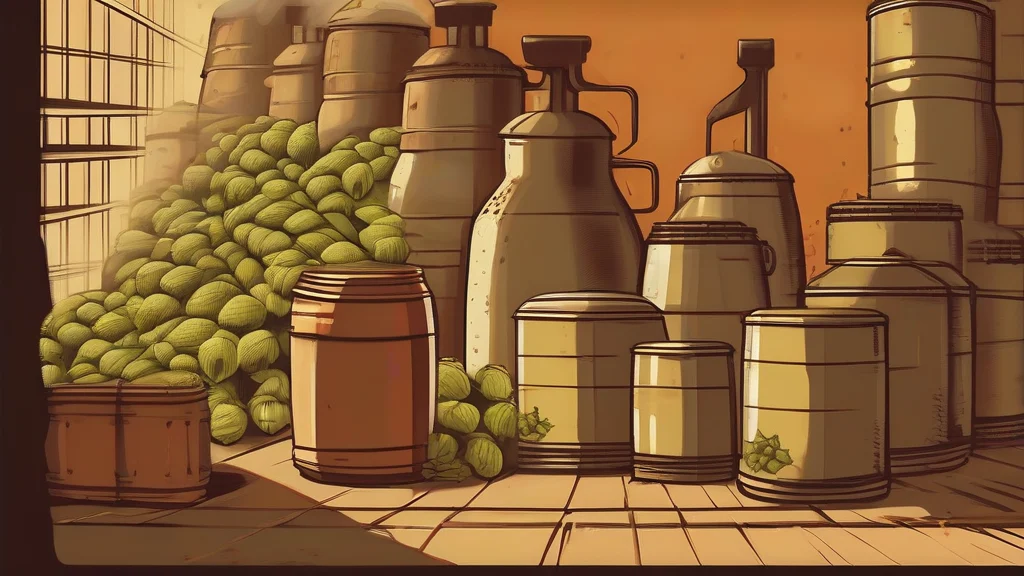
Bittering is a noun used chiefly in brewing and food production to describe what makes a product taste bitter. Its most common application is in beer making, where 'bittering hops' — varieties rich in alpha acids such as Columbus, Chinook, or Magnum — are added at the beginning of the boil. Prolonged boiling extracts their bitter compounds while driving off delicate aromas, giving the finished beer its crisp, sharp edge and balancing residual sweetness from the malt. Beyond beer, the term extends to any bittering agent, such as gentian root in herbal bitters or quinine in tonic water. Bittering is deliberately technical rather than colloquial; it sits alongside terms like aroma hopping in the brewer's vocabulary and carries no emotional connotations, unlike the adjective 'bitter'. Understanding it offers a small window into how carefully bitterness — often dismissed as simply unpleasant — is actually engineered into many foods and drinks we enjoy.
nounBittering refers to the process or ingredient that imparts bitterness, most commonly in brewing, where 'bittering hops' with high alpha-acid content are boiled early to give beer its characteristic bitter flavour.
- The addition of bittering hops (high-alpha-acid varieties) during the boil to impart bitterness to beer.
- Any bittering agent or process used to give a sharp, bitter taste to food, drink, or medicine.
"The brewer added the bittering hops at the start of the boil to build a firm backbone of bitterness."
"For this pale ale, a single charge of bittering hops provides enough bite without overwhelming the malt."
"Gentian root has long served as a natural bittering agent in herbal tonics and aperitifs."
The plural is rare and generally unnecessary, since bittering is usually treated as an uncountable process or category; it may occasionally appear when referring to multiple distinct bittering agents.
"The recipe lists several bitterings, including gentian and wormwood."
In brewing, not all hops are created equal: some exist purely to make beer bitter, and brewers literally call them 'bittering hops'.
Reviewed by Deb Chak, Editor. AI-assisted content curated by RJS Tech Solutions LLP.
Etymology of bittering
Bittering derives from the adjective 'bitter', which comes from Old English 'biter', a word of Germanic origin shared with Old High German 'bittar' and related forms across Germanic languages, ultimately tracing back to Proto-Germanic roots. As a noun, 'bittering' arose through the common English pattern of forming nouns from verbs or participles ending in '-ing'. Its modern prominence is tied closely to the vocabulary of commercial brewing, where distinctions between bittering and aromatic ingredients became standardised in the nineteenth and twentieth centuries.
Related word forms
How bittering is actually used
Bittering is primarily a technical term used within brewing and food-production circles; it is rare in everyday conversation. In brewing contexts it contrasts with 'aroma hopping', where hops are added late for fragrance rather than taste. The word also appears as the present participle of the verb 'to bitter', though that verbal use is uncommon.
Easily confused with bittering
'Bitter' is an adjective describing a sharp, unpleasant taste or an acrimonious attitude, whereas 'bittering' is a noun naming the substance or process that creates bitterness.
'Bitterness' is the abstract quality or sensation itself, while 'bittering' denotes the means by which that quality is imparted, especially in brewing.