What does bladderwrack mean?
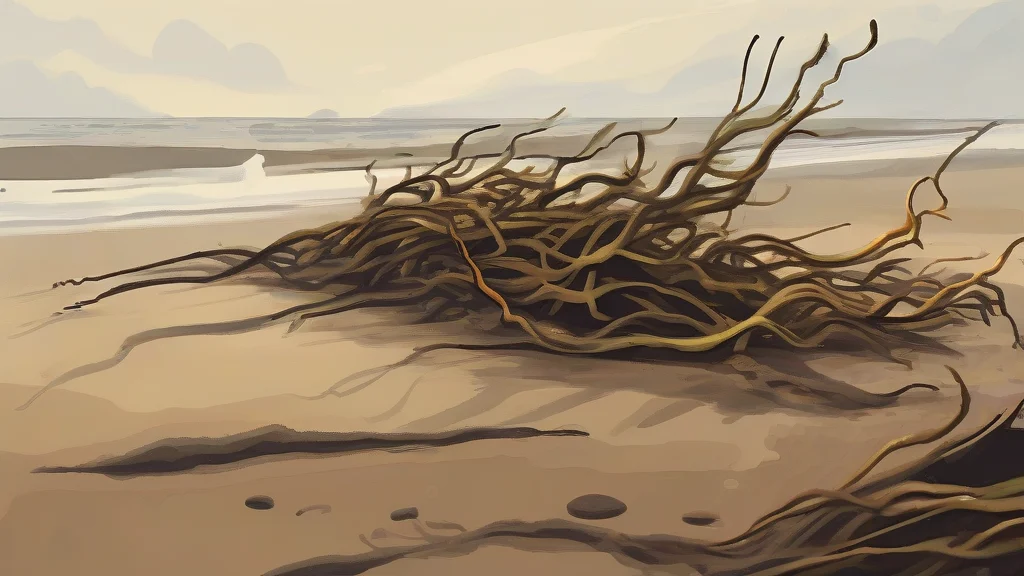
Bladderwrack is a common brown seaweed, Fucus vesiculosus, found attached to rocks along the Atlantic coasts of Europe and North America. Its name comes from the distinctive pairs of small, air-filled bladders running along its branched fronds, which keep the plant upright when the tide is in. The word entered English in the seventeenth century: 'bladder' describes those floatation sacs, while 'wrack' is an old Germanic term for seaweed generally, a word that also survives in 'wrack line' — the tide line of debris on a beach. Traditionally gathered by coastal communities for use as fertilizer, animal feed, and a source of iodine, bladderwrack today appears most often in two settings: in natural-history writing about shorelines, and in the health-food trade, where dried or extracted forms are sold as supplements. Because it is a specialist term, writers typically gloss it on first use, since most readers know the plant only as 'seaweed.'
nounA common brown seaweed (Fucus vesiculosus) of rocky North Atlantic coasts, characterized by paired air-filled bladders along its fronds and historically used as a source of iodine and as a fertilizer.
- The brown seaweed Fucus vesiculosus, with paired gas bladders along its fronds.
- Loosely, similar fucoid seaweeds used commercially for fertilizer, food additives, or herbal remedies.
"The rocks at low tide were slick with bladderwrack, its little air bladders popping underfoot."
"Fishermen spread dried bladderwrack on their fields as a traditional fertilizer."
"Herbalists have long valued bladderwrack as a natural source of iodine."
Usually treated as an uncountable mass noun referring to the plant material; a plural form exists but is rare, appearing mostly when distinguishing individual plants or species.
"Several different bladderwracks grew side by side in the tidal pool."
Bladderwrack's air-filled bubbles were once harvested to make fertilizer — and the word 'wrack' is an ancient Germanic term for seaweed itself.
Reviewed by Deb Chak, Editor. AI-assisted content curated by RJS Tech Solutions LLP.
Etymology of bladderwrack
Bladderwrack was formed in English in the early seventeenth century from 'bladder', referring to the seaweed's characteristic gas-filled floatation sacs, plus 'wrack', an old word for seaweed derived from Germanic roots. The element 'wrack' is related by origin to words such as 'wreck' and 'wreak', all descending from the same ancient Germanic verb family. The compound thus literally means 'the seaweed with bladders', a name coined by English speakers describing the plant's most visible feature.
How bladderwrack is actually used
A technical or specialist term used chiefly in marine biology, coastal natural history, and the herbal-supplement trade; unfamiliar to many general speakers, who would simply say 'seaweed'. It carries no strong connotation, being neutral-to-earthy in register.
Easily confused with bladderwrack
Bladderwort is a carnivorous freshwater plant that traps tiny aquatic animals in bladders, whereas bladderwrack is a marine brown alga whose bladders provide buoyancy.
Kelp properly refers to large brown seaweeds of the order Laminariales, though it is loosely used for any seaweed including bladderwrack, which is technically not a true kelp.