
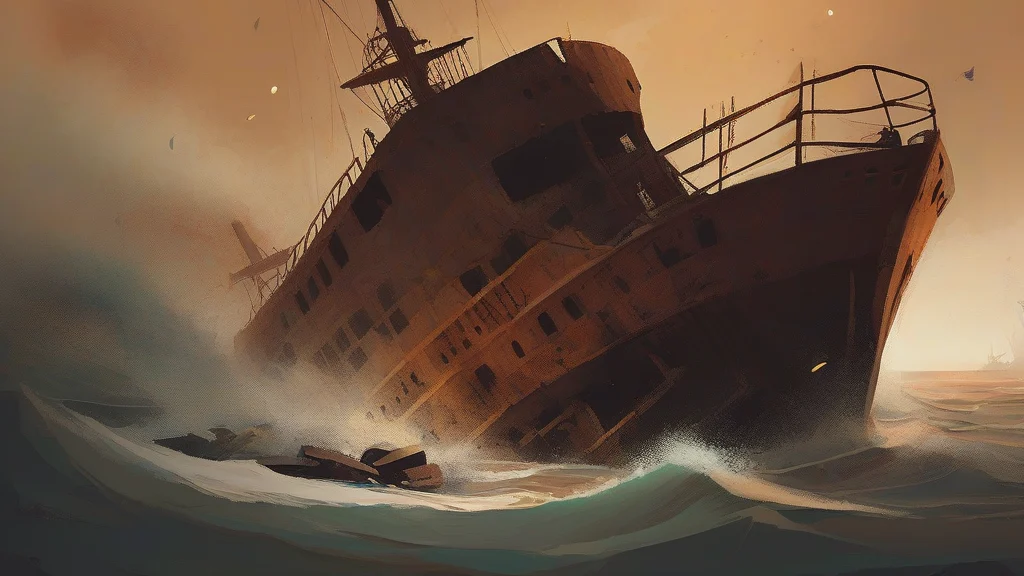
What does wreck mean?
“Wreck” describes something that has been severely damaged, destroyed, or rendered useless, and it can function as both a noun and a verb. As a noun, it may refer to a damaged vehicle or ship, the remains of a destroyed object, or a person in a ruined condition. As a verb, it means to cause serious destruction or ruin: a storm can wreck a boat, while a scandal may wreck a career or relationship. The word often suggests damage so extensive that ordinary repair is impossible. Figurative uses are common and vivid, especially in expressions such as “total wreck” and “wreck the economy.” “Wreck” is related etymologically to “wreak,” but the words have different functions: one destroys or ruins, while the other causes something such as havoc.
A vehicle, ship, structure, or other object that has been badly damaged or destroyed; also the remains of such an object or a person in a ruined condition.
"Rescuers searched the wreck for survivors."
To destroy, ruin, or render something useless; to damage a ship or vehicle severely.
"The careless driver wrecked the car on the icy road."
The plural refers to separate destroyed objects, vessels, accidents, or instances of ruin.
"The coast was littered with wrecks from the storm."
From the seafaring world: the word’s Old Norse ancestor referred to wreckage, so “wreck” still carries the image of a ship broken by violence.
Reviewed by Deb Chak, Editor. AI-assisted content curated by RJS Tech Solutions LLP.
Where does wreck come from?
The English word comes from Old Norse “rek,” meaning wreckage or the remains of a destroyed ship, and it entered Middle English during the period of Scandinavian contact. Its history is closely connected with seafaring, in which a wreck could mean both a ruined vessel and the scattered remains left behind. Cognates include German “Wrack,” Dutch “wrak,” Danish “vrag,” and Swedish “vrak,” reflecting the word’s shared Germanic and Norse ancestry.
Related word forms
How wreck is actually used
“Wreck” is neutral in register but often conveys severe and irreversible damage. As a noun, “car wreck” is especially common in North American English, where British speakers may more often say “crashed car” or “write-off.” “Wreck” is also used figuratively for plans, economies, and relationships.
Easily confused with wreck
Wreck means to destroy or ruin something, whereas wreak is used with words such as havoc or destruction to mean to cause them.