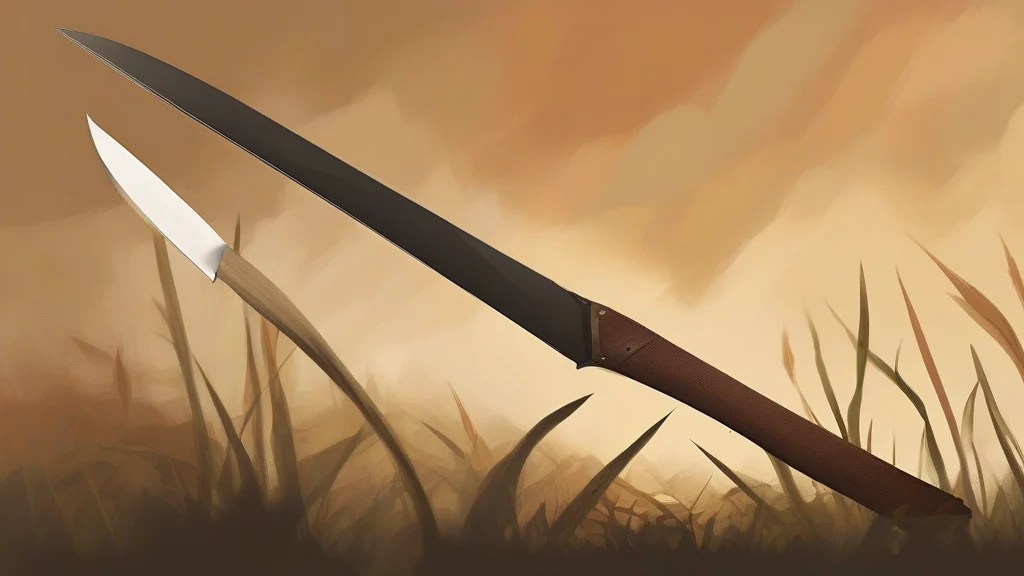
What does blade mean?
A blade is most familiar as the flat, sharpened portion of a tool or weapon — the working edge of a knife, sword, razor, or scalpel that does the actual cutting. The word extends naturally to anything flat and thin: a single blade of grass is one narrow leaf, a shoulder blade is the broad bone of the upper back, and a fan or turbine spins on blades that push air or water. Because it evokes sharpness and precision, 'blade' carries strong connotations of danger and skill, appearing often in phrases about violence ('a flash of steel'), craftsmanship, and sport. It also has older, more colorful uses: in literature, a 'blade' can mean a gallant or lively young man. Whether describing a surgeon's instrument or the first green shoot pushing through soil, the word consistently denotes something thin, flat, and effective at what it does.
The flat cutting edge of a knife, sword, or other tool or weapon.
"The chef's knife had a long, flexible blade ideal for filleting fish."
A single flat leaf of a plant, especially grass.
"A lone blade of wheat bent under the weight of morning dew."
A flat part of a machine that moves against air or water, such as a fan or propeller blade.
"Engineers replaced the damaged turbine blades before the jet returned to service."
(Rare/informal) To skate on ice skates.
"We spent the afternoon blading around the frozen pond."
Regular plural. Used both literally (knife blades, rotor blades) and idiomatically ('on the blades' for ice skating).
"The lawnmower's blades needed sharpening after a season of heavy use."
The word 'blade' once referred to the leaf of a plant — and botanists still call the flat part of a leaf its 'blade' to this day.
Reviewed by Deb Chak, Editor. AI-assisted content curated by RJS Tech Solutions LLP.
Etymology of blade
Blade comes from Old English 'blæd', which originally meant a leaf or the flat part of a plant, and is related to the verb 'to bloom' through the same Germanic root. The cutting-edge sense developed by analogy with the flat shape of a leaf and became established in Middle English. The word belongs to a wider Germanic family, with cognates in Dutch and other Germanic languages.
Related word forms
How blade is actually used
Mostly neutral in register. In informal speech, 'the blades' can refer to ice skates. The figurative use for a person is chiefly British, literary, or dated.
Easily confused with blade
A braid is an interwoven strand of hair or material, while a blade is the flat cutting part of a tool.
A glade is an open space in a forest; it shares no meaning with blade despite the rhyme.