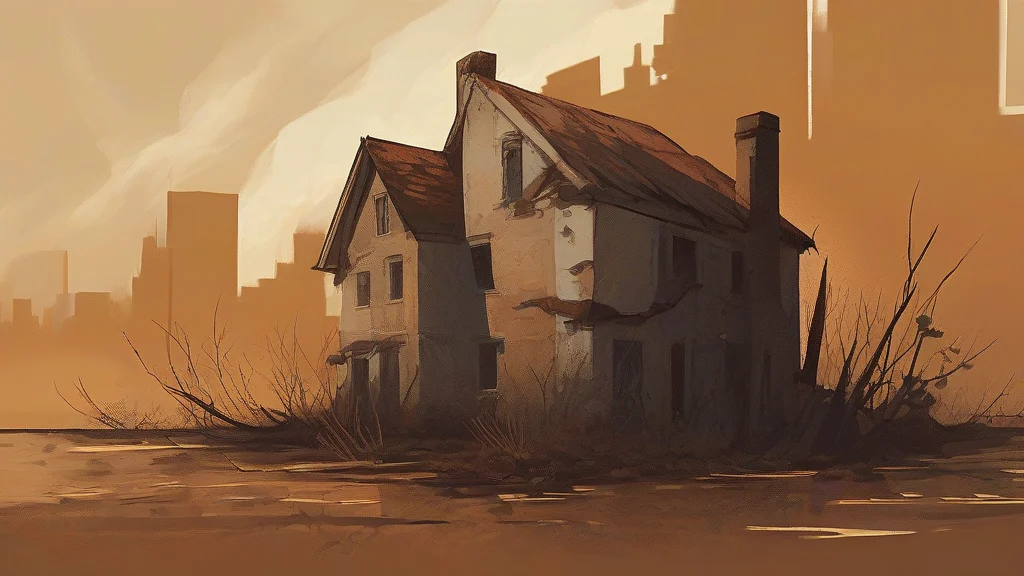
What does blighted mean?
Blighted describes something that has been damaged, spoiled, or prevented from reaching its natural potential. Originally applied to plants destroyed by disease — most famously the potato blight that devastated Ireland in the 1840s — the word broadened to describe decaying urban neighborhoods, ruined landscapes, and, figuratively, hopes, careers, or ambitions cut short by misfortune. A city might designate a 'blighted area' for redevelopment; a person's prospects may be described as 'blighted' by poverty or war. The word carries heavy negative connotation and appears frequently in journalism, official planning documents, and literary prose alike. It functions both as an adjective and as the past participle of the verb 'to blight', meaning to cause such damage. Its power lies in suggesting not just damage but a kind of curse — something fundamentally arrested in its growth.
Damaged, spoiled, or prevented from developing properly — used of plants stricken by disease, places suffering decay or neglect, or plans and prospects thwarted by misfortune.
"Rows of blighted elms had to be felled after the disease spread through the avenue."
In planning and property contexts, especially in Britain, 'blighted' specifically describes property devalued by proposed developments such as new roads.
Past participle of the verb 'blight': to have spoiled, damaged, or prevented something from developing properly.
"The scandal blighted his reputation for the rest of his political career."
Usually followed by a direct object ('blighted their chances') or used passively ('was blighted by').
Urban planners still use 'blighted' today as an official designation for neighborhoods so run-down they qualify for government redevelopment money — a word born in the potato fields of 1840s Ireland.
Reviewed by Deb Chak, Editor. AI-assisted content curated by RJS Tech Solutions LLP.
Etymology of blighted
The word 'blight', from which 'blighted' derives, first appeared in English in the early 17th century, though its deeper origin remains uncertain. It is generally thought to be connected to 'blast', sharing the notion of a violent, withering force, and some etymologists link it to Old Norse. The term originally named the sudden plant diseases that blackened crops and foliage, gaining lasting cultural weight during the Irish potato famine of the 1840s, when potato blight destroyed harvests across Europe. From this agricultural sense it extended naturally to urban decay and, figuratively, to any spoiled or thwarted prospect.
Related word forms
How blighted is actually used
Carries strongly negative connotations across all uses. In British English, 'blight' and 'blighted' are especially common in planning and property contexts, where a house 'blighted' by a proposed road or development loses value through no fault of its own. The word is standard rather than informal, appearing frequently in journalism and official reports.
Easily confused with blighted
'Slighted' means treated with disregard or disrespect, while 'blighted' means damaged, spoiled, or blighted by disease, decay, or misfortune.