
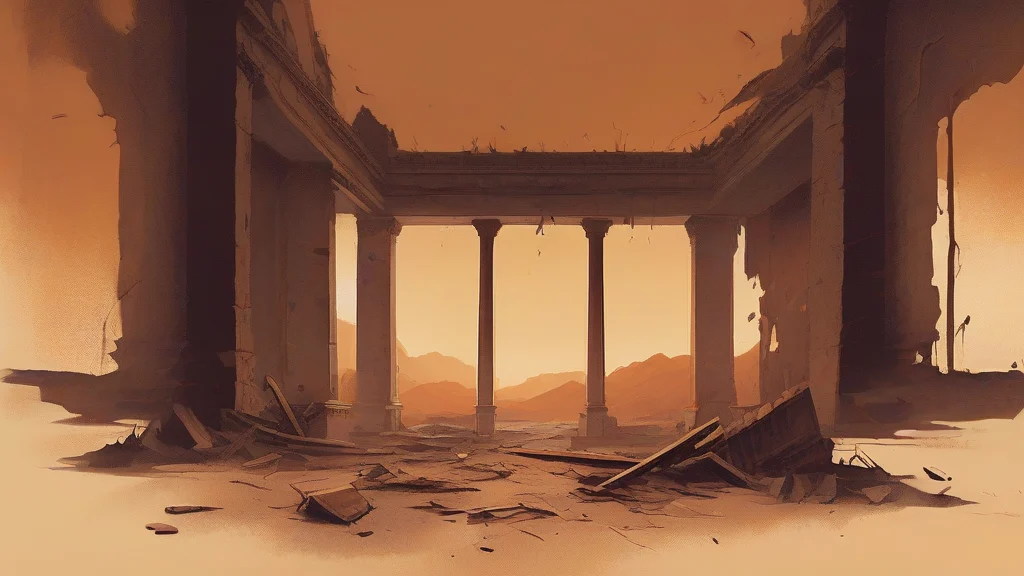
What does ruined mean?
Ruined means destroyed, badly damaged, or otherwise brought to a state from which recovery is difficult or impossible. The word is especially associated with physical destruction, as when weather ruins a building or crop, but it also describes financial ruin, ruined careers, damaged reputations, and thwarted plans. Because “ruined” suggests damage so severe that ordinary repair will not suffice, it often conveys finality more strongly than words such as “spoiled.” As a past-tense or past-participle verb form, it appears in constructions such as “The flood ruined the road,” while its adjectival use describes a person or thing already in that condition: “a ruined castle,” “a ruined reputation.” The word is equally natural in formal and informal English and has no significant regional distinction between standard British and American usage.
To destroy completely, damage irreparably, or cause to deteriorate beyond recovery; also, to bankrupt or discredit.
"The decision to cancel the festival ruined the organizers' finances."
This is the past tense and past participle of ruin. It may be transitive or used predicatively, as in “The business is ruined.”
Destroyed, severely damaged, bankrupt, disgraced, or otherwise in a state from which recovery is unlikely.
"They converted the ruined warehouse into an art centre."
Common in both attributive and predicative positions, including “a ruined house” and “the house lay ruined.”
One word can cover everything from a shattered building to a bankrupt business and a reputation in tatters: ruined.
Reviewed by Deb Chak, Editor. AI-assisted content curated by RJS Tech Solutions LLP.
Where does ruined come from?
English borrowed the noun ruin in the Middle English period from Old French ruine, which came from Latin ruina, meaning “ruin” or “collapse.” The related Latin verb ruinare provided the model for English verbal forms such as ruined. The ultimate origin of Latin ruina is uncertain, although it is often connected with rumus, an old term associated with a fallen or collapsed structure. English derivatives include ruination, ruinous, and the archaic verb ruinate.
Related word forms
How ruined is actually used
The form is common both as a past-tense verb and as a participial adjective. It can stand alone without a comparative marker: something may simply be ruined. Its figurative uses often carry the stronger implication of irreversible damage, financial collapse, or social disgrace.
Easily confused with ruined
A ruled place is governed or controlled, whereas a ruined place has been destroyed, severely damaged, or brought to financial collapse.