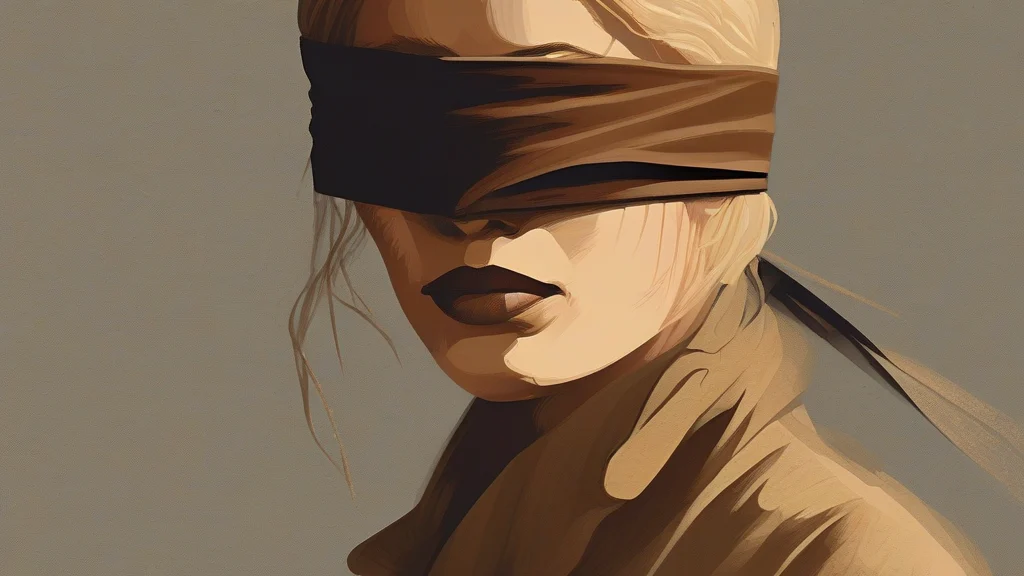
What does blindfolded mean?
"Blindfolded" describes someone whose eyes are covered with a cloth or bandage so that they cannot see. It functions chiefly as an adjective and as the past participle of the verb "blindfold," appearing both before nouns ("a blindfolded prisoner") and after linking verbs ("he was blindfolded"). The word is common in everyday contexts such as party games, taste tests, trust exercises, and magic tricks, where sight is deliberately removed to heighten other senses or add suspense. It also carries a darker register in reports of captives being led away blindfolded. Figuratively, it can suggest acting in ignorance — making a choice "as if blindfolded." Its component "fold" is an archaic English word for a bandage or wrapping, giving the term a lineage stretching back to Old English.
Having the eyes covered so as to prevent seeing.
"A blindfolded volunteer was asked to guess the object by touch alone."
Past participle of 'blindfold': having covered someone's eyes with a blindfold.
"The guards had blindfolded the prisoners before leading them out."
The 'fold' in 'blindfolded' has nothing to do with folding cloth — it comes from an Old English word for a piece of cloth or bandage tied over the eyes.
Reviewed by Deb Chak, Editor. AI-assisted content curated by RJS Tech Solutions LLP.
Etymology of blindfolded
"Blindfolded" derives from the verb "blindfold," a compound of Middle English elements: "blind" (from Old English "blind") and "fold," an Old English word meaning a bandage or piece of cloth used to wrap or tie — unrelated to the modern sense of "fold" as in bending fabric. The compound dates back to medieval English and has remained stable in form and meaning since. Related formations include "blindside" and "colorblind," which combine the same Germanic root "blind" with other elements rather than deriving from Latin or Greek cognates.
Related word forms
How blindfolded is actually used
Common in both literal contexts (games, tests, hostage situations) and figurative ones describing guesswork or uninformed decisions. Often used attributively ('a blindfolded man') or predicatively after verbs like 'was', 'remained', or 'did something blindfolded'.
Easily confused with blindfolded
'Blinded' means having lost or been deprived of sight altogether (permanently or temporarily), whereas 'blindfolded' specifically means having the eyes covered by a cloth so that a normally sighted person cannot see.