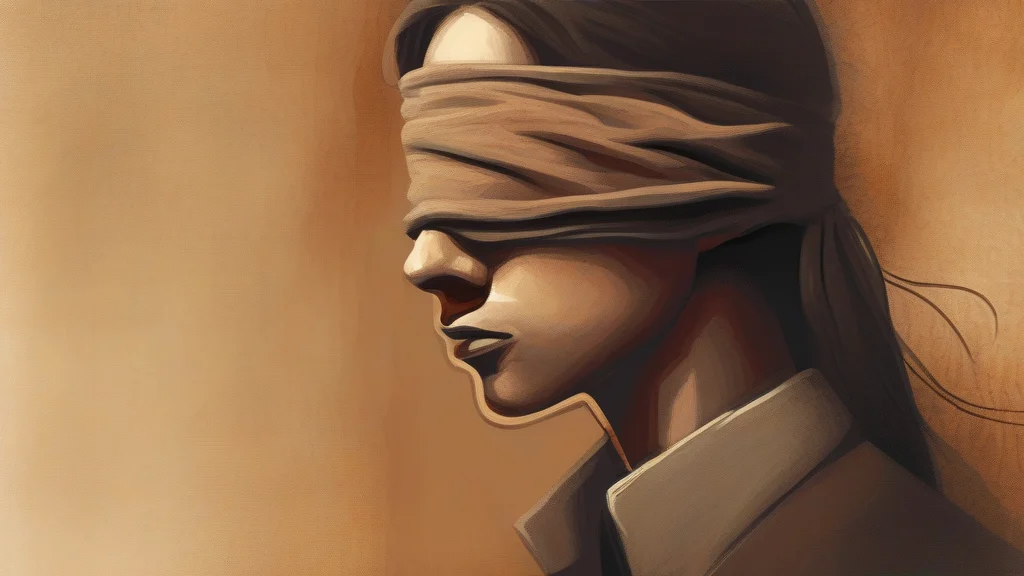
What does blindfold mean?
A blindfold is a strip of cloth or similar material tied over a person's eyes to block their vision. The word also functions as a verb: to blindfold someone is to place such a covering over their eyes, often to prevent them from knowing where they are or what is happening around them. Blindfolds appear across many domains — children's party games like pin the tail on the donkey, trust-building exercises, magic tricks, interrogation scenes in fiction, and certain religious or ceremonial practices where sight is symbolically restricted. Figuratively, being 'blindfolded' suggests being kept in ignorance or deprived of information. The word derives from the combination of 'blind' and an older sense of 'fold,' meaning to bind or wrap. Its derivatives include 'blindfolded' and 'blindfolding,' both widely used.
A piece of cloth or similar material tied over the eyes to prevent the wearer from seeing.
"He adjusted his blindfold before the game began."
Commonly used in contexts involving games, rituals, or concealment.
To cover someone's eyes with a blindfold, preventing them from seeing.
"The guards blindfolded the prisoner before escorting him out."
Often used in the passive construction 'to be blindfolded.'
Standard plural; used when referring to multiple blindfolds, e.g., in equipment lists or group activities.
"We bought several blindfolds for the team-building workshop."
The word 'blindfold' literally combines 'blind' and 'fold' — but the 'fold' isn't about folding fabric; it's an old sense of 'fold' meaning 'to bind or wrap around.'
Reviewed by Deb Chak, Editor. AI-assisted content curated by RJS Tech Solutions LLP.
Etymology of blindfold
The word 'blindfold' comes from Middle English, combining 'blind' with an older sense of 'fold' meaning to bind or wrap around something. It has been used since at least the medieval period, appearing in early English texts. The word is transparently compositional in origin, formed from native Germanic elements rather than borrowed from Latin or French, making it one of many English words built from 'blind.'
Related word forms
How blindfold is actually used
'Blindfold' is neutral in register and common in both literal contexts (games, kidnapping narratives, sensory-deprivation exercises) and figurative ones. The past participle form 'blindfolded' is more commonly used as an adjective than 'blindfold' itself.
Easily confused with blindfold
'Blindfold' refers to a covering over the eyes preventing sight, while 'blinkered' refers to side-flaps on a horse's bridle, or figuratively, narrow-minded thinking.