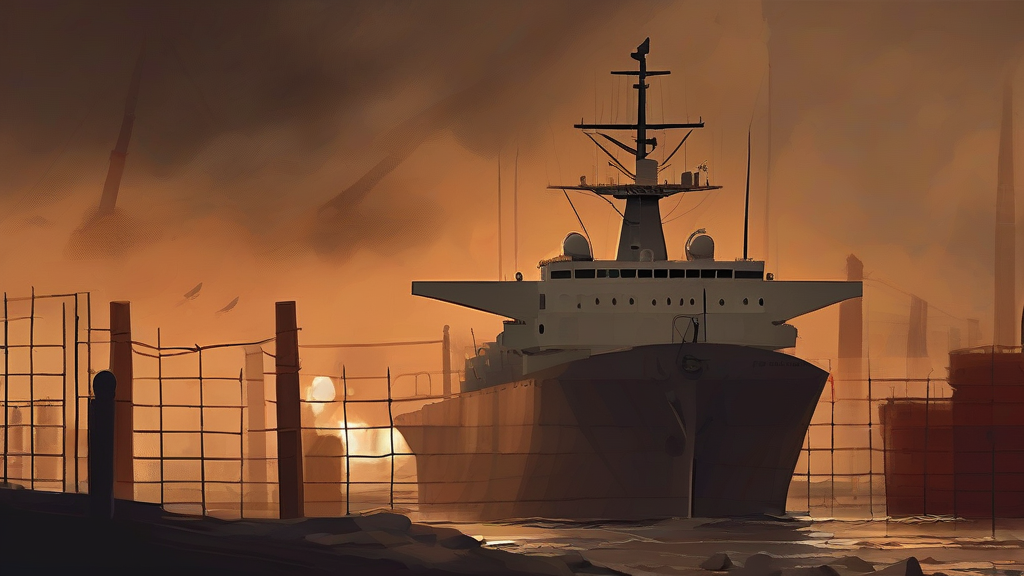
What does blockade mean?
A blockade is the deliberate act of sealing off a place — most often a port, coastline, or entire country — so that goods, supplies, or people cannot enter or leave. The word is most familiar in military and naval contexts: nations have long used blockades as instruments of war, aiming to starve an enemy of resources without direct assault. Beyond warfare, blockade is used more broadly for any complete obstruction, whether protesters physically blocking a road, a jam of traffic, or a figurative barrier standing in the way of progress. It can function as both a noun and a verb, allowing speakers either to describe the barrier itself ('the blockade lasted six months') or the act of imposing it ('they blockaded the harbor'). The term carries weighty connotations of confinement, hardship, and coercion, which is why it appears prominently in news coverage of conflicts and sieges. Related terms include embargo, which denotes a legal trade ban rather than a physical cordon, and siege, which implies active assault rather than mere isolation.
An act or means of isolating a place — especially a port, coast, or country — by forces or barriers so that goods and people cannot enter or leave.
"The naval blockade remained in place throughout the war, starving the city of imports."
Frequently modified by adjectives like 'naval', 'tight', or 'economic' to specify its nature.
To impose a blockade upon a place, cutting it off from communication or supply.
"Enemy forces blockaded the harbour, preventing any ships from docking."
Standard past forms are blockaded and blockading.
Regular plural; used when referring to multiple instances of blockading, historically or across different locations.
"History records numerous blockades of major ports during times of war."
During the American Civil War, daring ships that slipped through the Union's naval blockade were called 'blockade runners' — and their crews were celebrated as folk heroes for smuggling cotton out and supplies in.
Reviewed by Deb Chak, Editor. AI-assisted content curated by RJS Tech Solutions LLP.
Etymology of blockade
Blockade entered English in the early 17th century, during the era of European naval warfare, likely borrowed from Dutch blokkade or a similar continental source built on the root 'block' — ultimately from Old French bloc, meaning a solid mass of wood or stone. The '-ade' suffix, common in words denoting actions or results (as in parade and barricade), marks it as a term of action. Its close cousin 'barricade' shares this suffix pattern, and the underlying idea of blocking passage connects it to the broader family of 'block' words in English.
How blockade is actually used
Most strongly associated with military and naval contexts, where it carries serious, often humanitarian connotations; the verb form is slightly less common than the noun but standard in both formal journalism and everyday use. In figurative uses (traffic, emotions), the word retains its sense of total obstruction rather than partial delay.
Easily confused with blockade
A blockade is typically a physical or military sealing-off of a place, while an embargo is a legal or official prohibition on trade.