What does blockhouse mean?
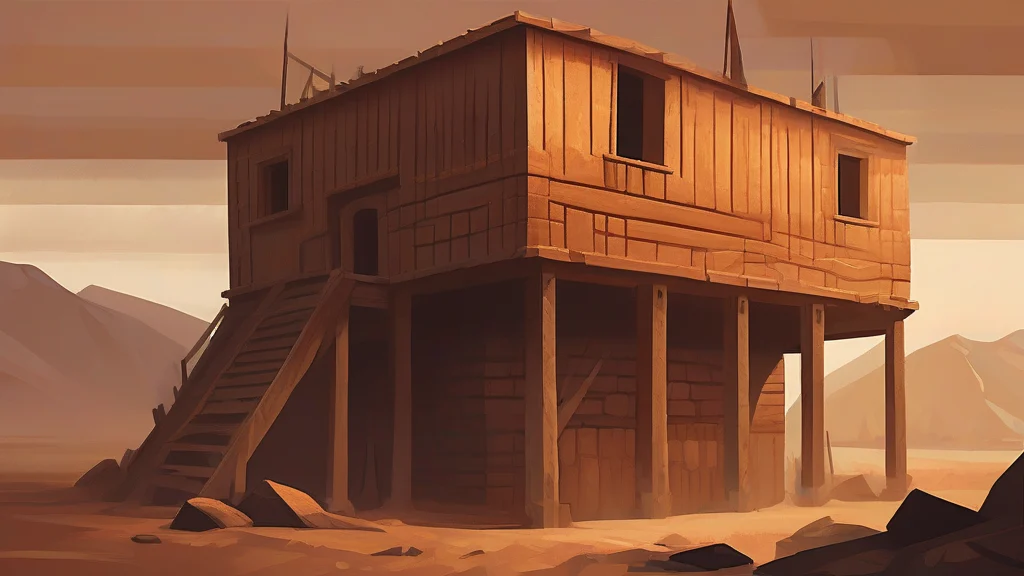
A blockhouse is a fortified structure designed to withstand attack, traditionally built of heavy squared timbers — and later of concrete or brick — and fitted with loopholes through which defenders could fire at assailants while remaining protected. Blockhouses were a fixture of military architecture from medieval Europe to the colonial frontiers of North America, where they often formed the strongest point of a larger fort, sometimes with a deliberately overhanging upper storey that allowed defenders to cover the base of the walls. Today the word appears mostly in historical writing, heritage tourism, and military history, describing both surviving structures and their role in frontier defence. The term carries a connotation of sturdy, functional solidity rather than grandeur: a blockhouse was practical engineering, not a castle. Its close association with the ordinary noun 'block' makes its meaning transparent — quite literally a stronghouse made of blocks of timber.
nounA fortified structure, typically of heavy timber or concrete, used as a defensive stronghold or a point from which gunfire can be directed; in North American history, especially an upper storey of a fort built with overhanging walls and loopholes for firing on attackers.
- A fortified military building, usually square with loopholes, used for defence and observation.
- (Historical, North America) A two-storey log fortification with an overhanging upper storey, characteristic of colonial frontier forts.
"The soldiers took refuge in the blockhouse when the raiders attacked at dawn."
"A stone blockhouse still guards the entrance to the old harbour."
"Pioneers sheltered inside the blockhouse until the siege was lifted."
Regular plural; the word is countable.
"Several blockhouses dotted the valley along the old defensive line."
American frontier blockhouses were built with the upper floor jutting out past the lower one — so defenders could drop or fire straight down on anyone trying to scale the walls.
Reviewed by Deb Chak, Editor. AI-assisted content curated by RJS Tech Solutions LLP.
Etymology of blockhouse
Blockhouse entered English in the late Middle Ages or early 16th century, most likely borrowed from the Dutch 'blokhuis', meaning a wooden fortification or lock-up, during a period of intense naval and military exchange between England and the Low Countries. It combines 'block' — referring to heavy squared logs or timbers, ultimately of Germanic origin — with 'house'. The Germanic root behind 'block' also gives us related borrowings such as 'blockade' (via French) and 'bloc'. The word has remained essentially stable in form and meaning since its adoption, always denoting a small, solidly built defensive structure.
How blockhouse is actually used
Blockhouse is a formal-to-neutral term found mainly in historical, architectural, and military contexts. In everyday modern English it is uncommon outside discussions of forts, colonial history, or surviving heritage buildings. The word is countable and takes the regular plural 'blockhouses'.
Easily confused with blockhouse
A bunker is typically an underground or heavily reinforced concrete shelter, whereas a blockhouse is an above-ground, often timber-built defensive structure.
An outhouse is a small outbuilding such as a shed or toilet, while a blockhouse is specifically a fortified military structure.