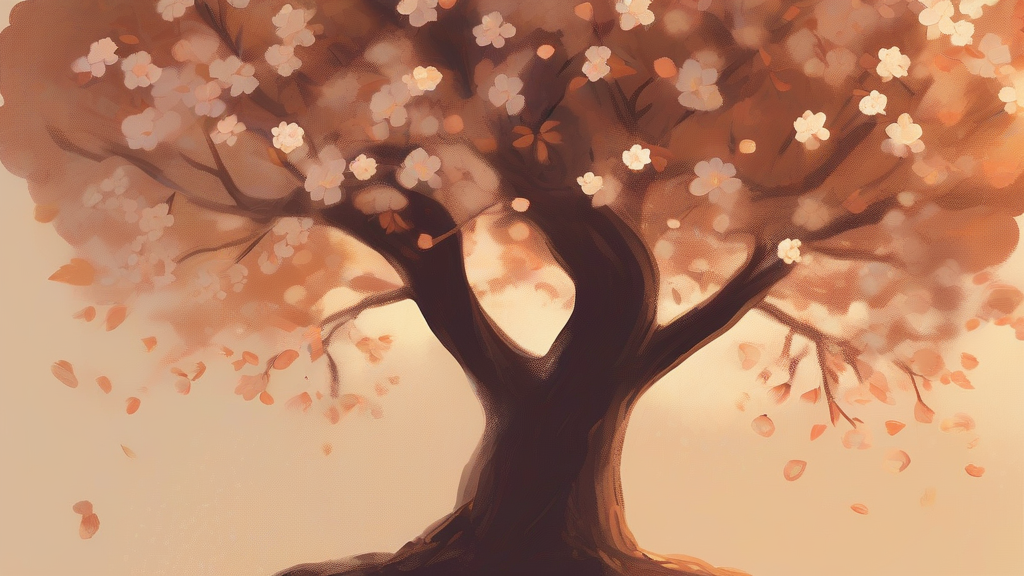
What does blossom mean?
Blossom refers primarily to the flowers produced by trees and shrubs — particularly fruit-bearing species like cherry, apple, plum, and almond — before they develop into fruit. The word functions as both a noun and a verb. As a noun, it denotes the flower itself or the collective flowering of a tree ('the garden was full of blossom'); as a verb, it means to open into flower, and figuratively, to develop or flourish, as when a shy child 'blossoms' into confidence. Blossom carries strongly positive connotations: freshness, renewal, youth, and promise. It is especially associated with springtime and is culturally significant — most famously in Japan, where cherry blossom viewing (hanami) celebrates the transient beauty of the sakura. Common collocations include 'cherry blossom', 'in full blossom', and 'apple blossom'. Distinguish it from the broader term 'flower', which applies to all plants, whereas blossom is reserved for woody, usually fruit-producing trees and shrubs. Its blend of literal botanical precision and figurative warmth makes it a versatile and much-loved word in English.
A flower of a tree or shrub, especially one that yields edible fruit; also the collective flowering of such a plant or the period during which it occurs.
"The orchard was a sea of white blossom in late April."
Often used uncountably ('in blossom') for massed flowers on trees.
(Of a tree or shrub) to produce flowers; figuratively, to develop healthily, flourish, or reach maturity.
"Her confidence blossomed once she joined the debating club."
The figurative sense usually takes the pattern 'blossom into something'.
Used when referring to individual flowers counted separately; uncountable 'blossom' is used for massed flowering on a tree.
"She pressed pink cherry blossoms between the pages of her notebook."
In Japanese culture, cherry blossoms bloom for only about a week each year — their brief beauty is celebrated as a symbol of life's fleeting nature.
Reviewed by Deb Chak, Editor. AI-assisted content curated by RJS Tech Solutions LLP.
Etymology of blossom
Blossom derives from Old English 'blōstm(a)', meaning a flower or the act of flowering, which itself traces back to Proto-Germanic roots related to blooming. It shares ancestry with words for flowers and blooming across Germanic languages, including Old Norse 'blómstr'. Closely related to the verb form that developed from the same root, it has carried both its botanical and figurative senses since medieval times.
Related word forms
How blossom is actually used
Blossom carries warm, positive connotations — it evokes springtime, renewal, and beauty. The figurative sense ('to blossom into') is common in literary and conversational contexts alike. In British English, 'blossom' often appears without an article ('the trees are in blossom'). It typically refers to mass flowering rather than individual blooms.
Easily confused with blossom
Blossom specifically refers to flowers on trees and shrubs (especially fruit-bearing ones), while bloom is the more general term for any flower and also describes healthy appearance.