
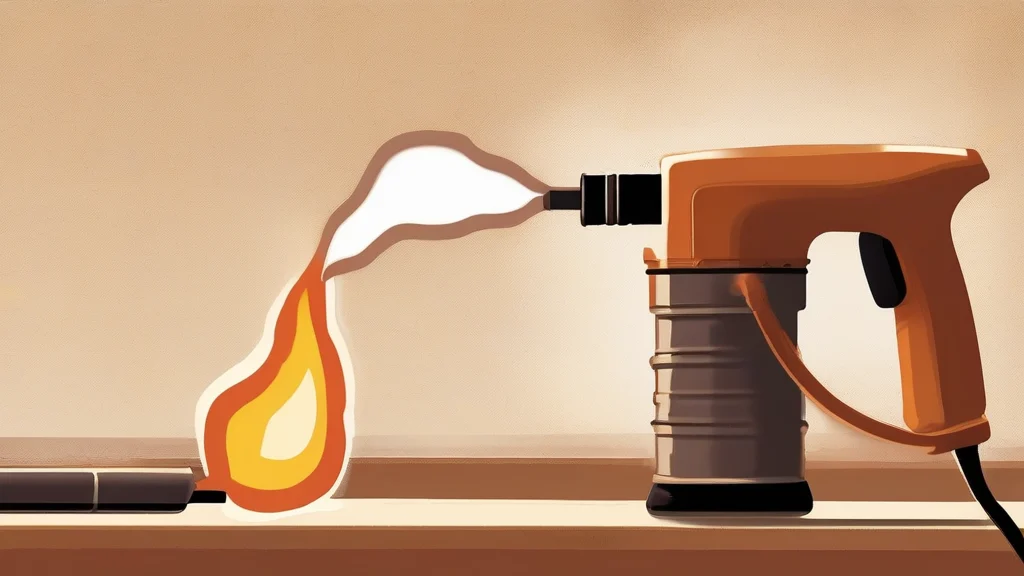
What does blowtorch mean?
A blowtorch is a portable device that generates a hot, focused flame by burning pressurized fuel — most commonly propane or butane today — through a nozzle. It is a staple of plumbing, metalwork, and building trades, where it is used for soldering copper pipe, brazing, welding-adjacent tasks, and stripping old paint, and it has also found a place in kitchens for caramelizing sugar or charring ingredients. The word combines "blow," referring to the forced airflow that intensifies the flame, with "torch." British English traditionally calls the same tool a blowlamp, though blowtorch is now common everywhere. Beyond its literal use, the word occasionally appears figuratively to describe intense heat or scathing force, as in a "blowtorch of criticism." Compact, inexpensive, and powerful, the blowtorch remains one of the most widely recognized hand tools, instantly evoking the image of a hissing blue flame.
nounA portable device that produces a hot, concentrated flame, typically fueled by propane, butane, or historically gasoline under pressure, used for tasks such as soldering, welding, stripping paint, and cooking. In British English the equivalent tool is often called a blowlamp.
- A portable burner producing a directed, intense flame, used for soldering, brazing, paint removal, welding-related work, and culinary finishing.
"The plumber used a blowtorch to sweat the copper pipes together."
"She fired up the blowtorch to caramelize the sugar crust on the crème brûlée."
"Stripping decades of old varnish from the doorframe took hours with a blowtorch and scraper."
Standard plural, following the regular -es pattern for words ending in -ch.
"The workshop had three blowtorches hanging on the wall."
The blowtorch predates electricity as a precision tool — craftsmen once pumped air by hand into gasoline-fueled tanks to keep its flame roaring.
Reviewed by Deb Chak, Editor. AI-assisted content curated by RJS Tech Solutions LLP.
Where does blowtorch come from?
The word "blowtorch" is a straightforward English compound formed from "blow" (of Old Norse and Middle English origin) and "torch" (from Old French "torche," ultimately from Vulgar Latin "torca"/"torta," meaning something twisted). The compound arose in the nineteenth century alongside the development of pressurized-flame tools: early versions burned gasoline vaporized and blown through a nozzle by hand-pumped air, later giving way to safer propane and butane models in the twentieth century. Its British synonym "blowlamp" reflects the same idea of a lamp-like burner driven by forced air.
How blowtorch is actually used
Common in both everyday and technical registers. In British English, "blowlamp" is the traditional term for the same tool; "blowtorch" is also widely understood and used there. Figurative uses exist (e.g., "a blowtorch of criticism") but are informal.
Easily confused with blowtorch
In American English a torch is a handheld light (or, in British English, a flashlight), whereas a blowtorch is a device producing an open flame for heating or burning.