
What does bluefish mean?
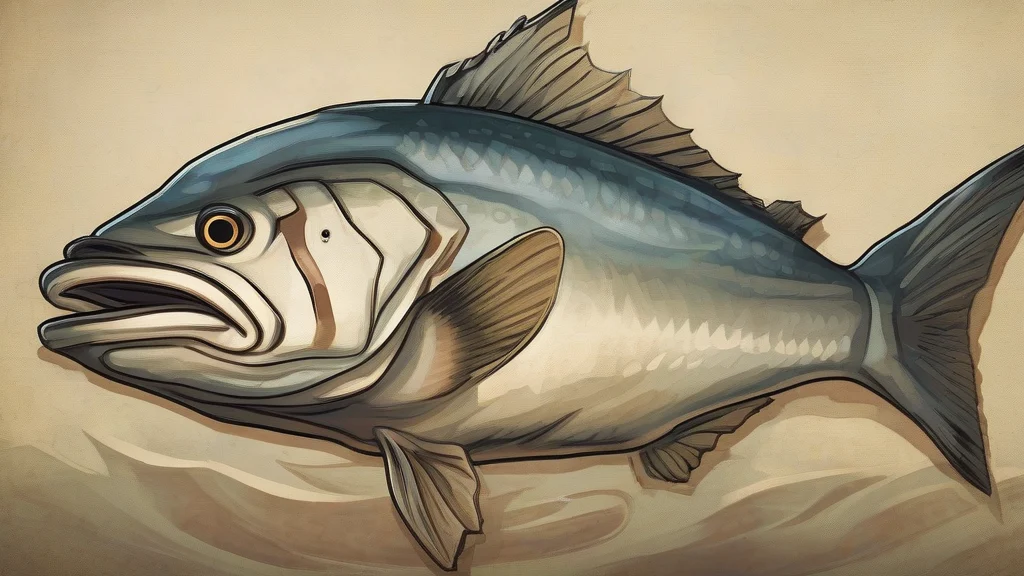
The bluefish (Pomatomus saltatrix) is a powerful, fast-swimming marine fish found throughout warm and temperate coastal waters around the world. Recognizable by its blunt head, forked tail, and steel-blue to greenish back, it is a relentless predator that hunts in schools, feeding on smaller fish such as menhaden and herring. This aggression has made it one of the most sought-after sport fish along the Atlantic coast of North America, where anglers prize its hard strikes and strong fight — earning it nicknames like 'chopper'. The bluefish's flesh is dark and oily; it does not keep well on ice and is best eaten extremely fresh, whether grilled, baked, or smoked into spreads. Known regionally as 'tailor' in Australia and 'elf' in South Africa, the bluefish remains both an ecological force and a cultural fixture of coastal fishing communities.
A voracious, schooling marine fish (Pomatomus saltatrix) with a bluish-green back and silvery sides, occurring worldwide in warm and temperate seas and valued as a game fish.
"Bluefish arrive off the New England coast each summer in pursuit of migrating baitfish."
Plural usually unchanged ('bluefish'); 'bluefishes' is also acceptable.
The flesh of the bluefish used as food, typically prepared fresh due to its tendency to spoil quickly.
"The restaurant featured grilled bluefish with lemon and herbs on its summer menu."
In everyday and angling usage the plural typically mirrors the singular, especially after numerals; 'bluefishes' appears more often in formal or scientific writing.
"Anglers reported catching dozens of bluefish during the fall run."
Anglers nickname it the 'chopper' because a school of bluefish can slash through a bait pod so violently the sea appears to be boiling.
Reviewed by Deb Chak, Editor. AI-assisted content curated by RJS Tech Solutions LLP.
Etymology of bluefish
The word 'bluefish' arose in English as a straightforward compound of 'blue', referring to the fish's distinctive coloration, and 'fish', with usage attested from at least the early colonial period in North America. The element 'blue' itself traces back through Old French 'bleu' to a Germanic root. Regional common names developed independently: Australian English adopted 'tailor', while South African English uses 'elf', giving the single species several folk names across the English-speaking world.
How bluefish is actually used
The plural is commonly left unchanged ('three bluefish'), though 'bluefishes' is also accepted. In Australia the species is widely known as 'tailor', and in South Africa as 'elf'; using those names elsewhere may confuse readers.
Easily confused with bluefish
A bluegill is a small freshwater North American sunfish (Lepomis macrochirus), whereas the bluefish is a large predatory saltwater species.
A blowfish (pufferfish) can inflate its body and carries toxins, while the bluefish is a streamlined predatory game fish with no such defenses.