What does bluejeans mean?
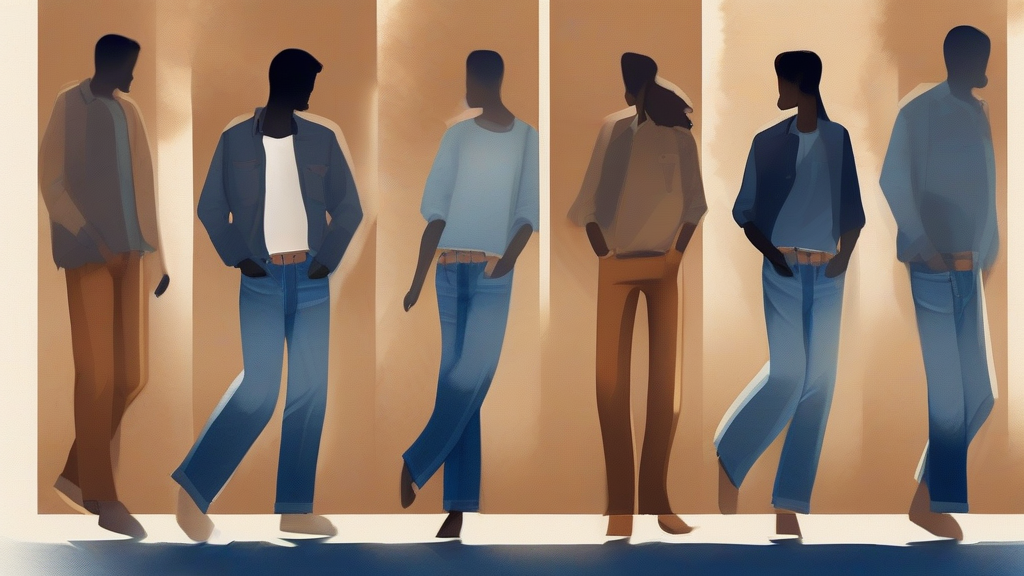
Bluejeans are trousers cut from sturdy cotton denim dyed blue with indigo, usually featuring reinforced stitching and metal rivets at stress points. Almost invariably used in the plural, the noun belongs to informal registers and evokes casualness, practicality, and everyday style — a garment equally at home on a farm, a campus, or a fashion runway. Speakers refer to a single item as "a pair of blue jeans" rather than using a singular form. The word's history is surprisingly cosmopolitan: "jean" derives from the name of the Italian port city of Genoa, which produced a durable twill cloth exported across Europe centuries ago, while the blue color reflects the indigo dye long favored for workwear. Today bluejeans are among the most universally recognized garments worldwide, worn across cultures and social classes, making the word both commonplace and culturally resonant.
nounA pair of trousers made of blue denim, typically riveted and stitched for durability; the term is almost always used in the plural.
- Trousers made of blue denim fabric, worn casually by people of all ages; treated as a plural noun.
"He wore a plain white T-shirt and faded bluejeans to the interview."
"She rolled up the cuffs of her bluejeans and waded into the surf."
"The dress code said business casual, so he traded his suit for a blazer over bluejeans."
The word functions as a pluralia tantum noun — it has no common singular form. To refer to one garment, say "a pair of blue jeans."
"I only packed one pair of bluejeans for the trip."
The "jean" in bluejeans comes not from any color or person, but from Genoa, Italy — the city whose name gave the world its most-worn pair of pants.
Reviewed by Deb Chak, Editor. AI-assisted content curated by RJS Tech Solutions LLP.
Etymology of bluejeans
The element "jean" traces back to the French "Gênes," meaning Genoa, the Italian city renowned for producing a hardwearing twilled cotton cloth; the fabric itself came to be called "jean" in English by the sixteenth century. The distinctive blue color comes from indigo dye, traditionally applied to denim workwear because it masked dirt and aged attractively. Blue jean trousers became iconic in the United States in the nineteenth century, popularized as durable laborers' wear before evolving into a global casual staple. The related fabric term "denim" has a separate origin, from the French phrase "de Nîmes" ("from Nîmes").
How bluejeans is actually used
"Bluejeans" is nearly always used in the plural form; referring to a single item is done via "a pair of blue jeans" or "one blue jean," though the latter is rare. The closed spelling "bluejeans" is less common than the open compound "blue jeans." The word carries an informal, casual connotation, associated with everyday wear rather than formal dress.
Easily confused with bluejeans
"Genes" are units of heredity in biology, whereas "bluejeans" are trousers of blue denim — the two words are exact homophones but unrelated in meaning.