What does blueweed mean?
Blueweed is the common name for Echium vulgare, a bristly-stemmed plant of the borage family native to Europe and western Asia and now widely naturalized across North America. It grows on dry, sandy, or chalky ground, producing rough leaves and tapering spikes of flowers that open pink and mature to a striking blue, giving each stem a two-toned appearance at its peak in early summer. The plant is rich in nectar and highly attractive to bees, making it valued by some beekeepers and gardeners, yet elsewhere it carries strongly negative connotations: it spreads aggressively, displaces native vegetation, and contains alkaloids that make it toxic to grazing livestock, so several regions classify it as a noxious weed. The name reflects both its color and its weedy habit, and in North America it is the usual everyday term, while British usage more often favors 'viper's bugloss.' Knowing the word is useful to farmers, ecologists, and gardeners alike.
nounA bristly Eurasian plant (Echium vulgare) of the borage family, bearing spikes of showy bright-blue flowers; also known as viper's bugloss. It has been widely naturalized in North America, where it is often regarded as an invasive weed.
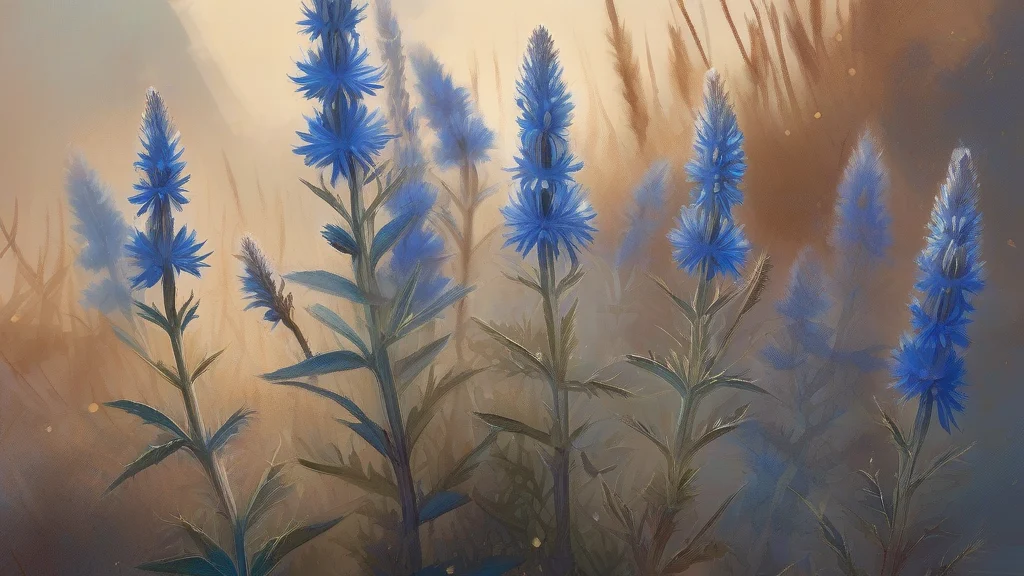
- The plant Echium vulgare (viper's bugloss), with its tall spikes of blue flowers.
"The roadside pastures were ablaze with blueweed by midsummer."
"Horses should not graze fields overrun with blueweed, as the plant is toxic to livestock."
"In June the chalk meadow turned hazy blue where the blueweed had self-seeded."
Usually treated as an uncountable mass noun when describing stands of the plant ('a field full of blueweed'); the plural appears mainly when counting individual specimens.
"Several blueweeds had taken root in the gravel driveway."
Its flowers start pink and turn vivid blue as they age — so a single spike can wear two colors at once, which is why beekeepers prize it even as farmers curse it.
Reviewed by Deb Chak, Editor. AI-assisted content curated by RJS Tech Solutions LLP.
Etymology of blueweed
Blueweed is a transparent English compound formed from 'blue,' from Old English blāw, and 'weed,' from Old English wēod, meaning a herbaceous plant or unwanted growth. Such compound common names arose in early modern English, when settlers and herbalists labeled familiar European plants anew in the Americas. It shares its elements with countless other compounds such as bluebell and ragweed, all built from the same ancient Germanic roots.
Related word forms
How blueweed is actually used
The term 'blueweed' is especially common in North American agricultural contexts, where the plant is treated as a noxious invasive species; in Britain it is more often called viper's bugloss and may be appreciated as a wildflower.
Easily confused with blueweed
Bugloss refers to plants of the related genus Anchusa (alkanets), whereas blueweed is the common name for Echium vulgare, though both are bristly members of the borage family.