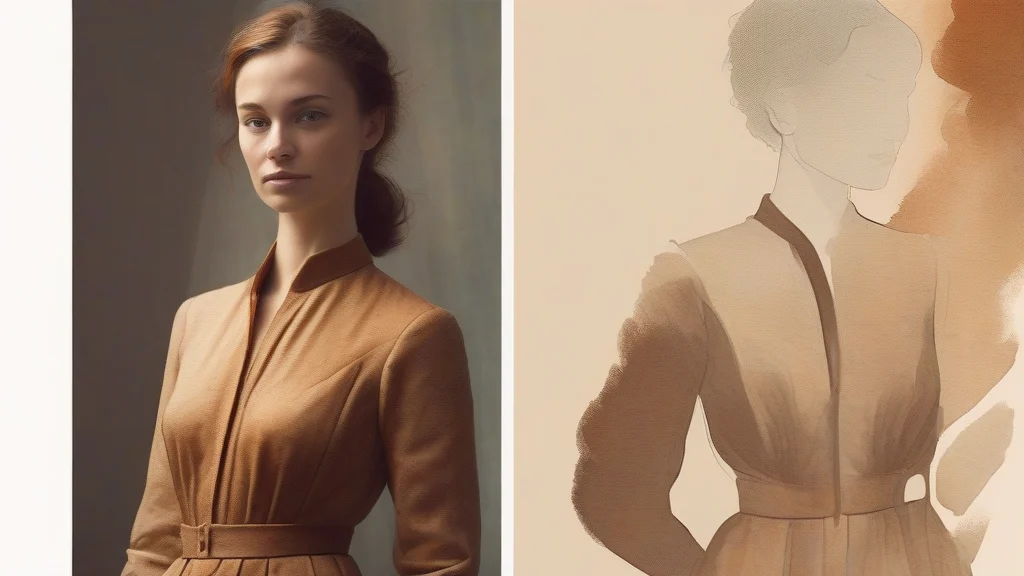
What does bodice mean?
A bodice is the fitted upper part of a woman's dress, extending from the shoulders or neckline down to the waist, or alternatively a separate, close-fitting garment worn over a blouse and fastened by lacing, buttons, or hooks. The word belongs chiefly to the vocabulary of fashion, sewing, costume design, and historical description, appearing frequently in discussions of wedding gowns, evening wear, Renaissance and Victorian dress, and theatrical costuming. Its connotations are largely feminine and often romantic or historical, evoking corsetry, lace, embroidery, and boned construction. The term has also entered popular culture through the phrase "bodice ripper," used to describe a genre of dramatic historical romance fiction. Etymologically intriguing as well as practical, "bodice" arose in the early seventeenth century as a variant spelling of "bodies," the plural of "body," since the garment covered the torso. Whether describing a designer's craftsmanship or a heroine's attire in period drama, the word remains a precise and evocative term for the part of a garment closest to the wearer's form.
The fitted upper part of a woman's dress, from the shoulders or neck to the waist.
"The seamstress carefully boned the bodice to give the gown its structured silhouette."
In dressmaking contexts, may refer either to the built-in top of a dress or to an underbodice worn beneath it.
A separate, sleeveless, close-fitting garment for the upper body, typically laced or buttoned at the front and worn over a blouse.
"She wore a burgundy velvet bodice over a cream linen shirt."
Common in descriptions of historical or folk costume; less frequent in contemporary casual fashion.
Standard regular plural, pronounced identically to the singular except for the added final /ɪz/.
"The costume shop stocked bodices in every fabric from brocade to plain cotton."
"Bodice" began life as the plural of "body" — Tudor tailors literally spoke of dressing a woman in her "pair of bodies."
Reviewed by Deb Chak, Editor. AI-assisted content curated by RJS Tech Solutions LLP.
Etymology of bodice
Bodice originated in English in the early seventeenth century as an altered form of "bodies," the plural of "body," because the garment encased the torso or "body" of the wearer. It was sometimes written as a "pair of bodies," reflecting its construction of two stiffened panels laced together. The underlying word "body" traces back to Old English "bodig." More distant cousins sharing the broader notion of the physical frame come from Latin "corpus," giving English words such as "corpse," "corporeal," "corps," and "embody."
How bodice is actually used
Primarily used in fashion, historical costume, and theatrical contexts. In everyday modern dress, the term appears most often when describing formalwear, wedding dresses, or period clothing. The compound "bodice ripper" refers colloquially to a genre of romance novel with dramatic historical cover art.
Easily confused with bodice
A corset is an undergarment designed to shape and cinch the waist, whereas a bodice is the visible upper section of a dress or an outer garment.