What does coppice mean?
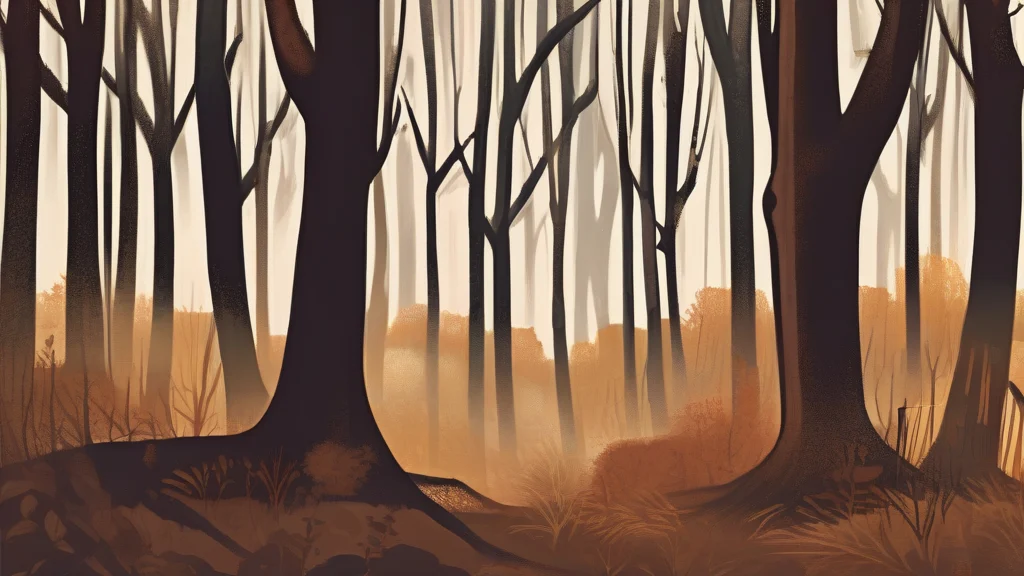
A coppice is an area of woodland managed by a traditional technique in which trees are cut back close to the ground so that they regrow from the stump, producing a dense crop of straight young stems. The word also describes the resulting mass of regrowth itself, and it can function as a verb meaning to carry out this cutting. Coppicing has been practised in Europe for thousands of years: species such as hazel, ash, lime, oak, and sweet chestnut respond readily, yielding poles for fencing, hurdles, charcoal, and firewood on rotations of roughly seven to thirty years. Because the root systems remain alive indefinitely, some coppices are far older than any individual tree growing in them, and their periodic cutting creates open, sunny conditions that benefit bluebells, butterflies, dormice, and other woodland wildlife. Today the term appears chiefly in British forestry, ecology, and countryside writing, where it evokes sustainable management and deep rural history rather than mere tree-felling.
An area of woodland in which trees are regularly cut back to ground level to encourage regrowth; also the regrowth itself.
"The foresters worked their way through the chestnut coppice, selecting stems ready for cutting."
In British usage often interchangeable with 'copse' in casual speech, though technically a copse need not be actively managed.
To cut a tree or shrub back to near its base so that it sprouts anew from the stump.
"They decided to coppice the overgrown willows along the riverbank to rejuvenate them."
Standard plural; used when referring to several distinct areas of managed woodland within a landscape or estate.
"The estate's ancient coppices had supplied firewood to nearby villages for generations."
Some of Britain's hazel coppices have been cut on rotation for over 1,000 years — making them among the oldest 'working' ecosystems on Earth, still alive because they keep being cut down.
Reviewed by Deb Chak, Editor. AI-assisted content curated by RJS Tech Solutions LLP.
Etymology of coppice
Coppice derives from Old French 'copez', the past participle of 'coper' meaning 'to cut', ultimately rooted in Latin 'caupo'/'capere'-related cutting verbs via Vulgar Latin *colpare, related to Greek kolaphos (a blow). It entered English in the late Middle Ages as a term for woodland cut for fuel and timber. The same French root gives English 'coup' (a blow or stroke) and 'coupon', reflecting the shared idea of a decisive cut. Its variant spelling 'copse' arose through contraction of 'coppice wood'.
Related word forms
How coppice is actually used
Coppice carries strong connotations of traditional British woodland management and is used more often and with greater familiarity in the UK than in North America. In ecological and forestry writing it signals sustainable, centuries-old practice rather than neglect. The verb form appears mainly in specialist contexts — forestry, conservation, and gardening literature — rather than everyday conversation.
Easily confused with coppice
A copse is simply a small stand of trees, whereas a coppice specifically denotes woodland managed by cutting trees back to regrow from the stump.
Coax means to persuade someone gently, and shares only a superficial phonetic resemblance with coppice.