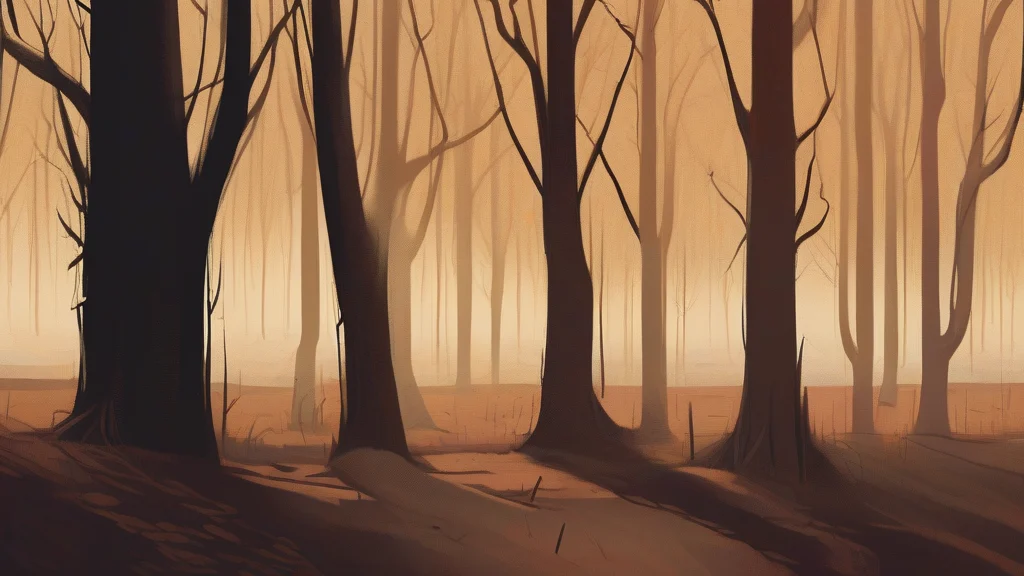
What does copse mean?
A copse is a small, dense stand of trees and shrubs — essentially a miniature woodland. The word is most at home in descriptions of rural landscapes, where a copse might dot a hedgerow, shade a country lane, or provide cover for birds and small animals. It is closely related to the term 'coppice', which refers more specifically to woodland managed by cutting trees back to the ground so they regrow as many-stemmed shoots; indeed, 'copse' originated as a shortened form of 'coppice'. Though familiar enough to most readers, 'copse' has a gently literary register and is used more frequently in British English than American English, where words like 'thicket' or 'grove' tend to take its place. Its connotations are almost entirely pleasant, evoking intimacy, shelter, and the quiet charm of the countryside. For writers seeking an evocative alternative to 'woods' or 'forest', a copse suggests something small enough to cross in moments yet rich enough to hold a world of its own.
nounA small group or thicket of trees and shrubs; a small woodland, especially one managed by periodic cutting of the stems.
- A small dense grove of trees or shrubs; a thicket.
- An area of woodland managed by coppicing, where trees are cut near the ground so they regrow as multiple stems.
"A narrow path led through a copse of birch trees at the edge of the field."
"They sheltered from the rain beneath the oaks of a small copse beside the lane."
"The ancient copse had been coppiced for centuries, its hazel stools sprouting anew each time they were cut."
Standard plural; used when referring to several such small woodlands across a landscape.
"The valley was dotted with copses of ash and hazel."
A 'copse' is literally named for being chopped: it comes from the same root as the word 'chop', because these little woods were cut down on purpose to grow back again.
Reviewed by Deb Chak, Editor. AI-assisted content curated by RJS Tech Solutions LLP.
Etymology of copse
'Copse' arose in late Middle English as a shortened form of 'coppice', borrowed from Old French 'copeiz', meaning cut-over woodland. The French term derives ultimately from medieval Latin forms based on 'colpus' (later 'coup'), meaning 'a blow' or 'a stroke' — the same root behind English 'chop', 'coup', and 'coupon'. The word thus literally names woodland defined by cutting: trees that are chopped down and allowed to regrow.
How copse is actually used
Slightly literary and chiefly British in flavor; 'copse' often appears in countryside writing and poetry. In North American usage it is understood but less common than 'thicket' or 'grove'. It carries pleasant pastoral connotations rather than any negative sense.
Easily confused with copse
A copse is a small stand of trees, while a corpse is a dead body — the two words sound nearly identical in some accents but are entirely unrelated.