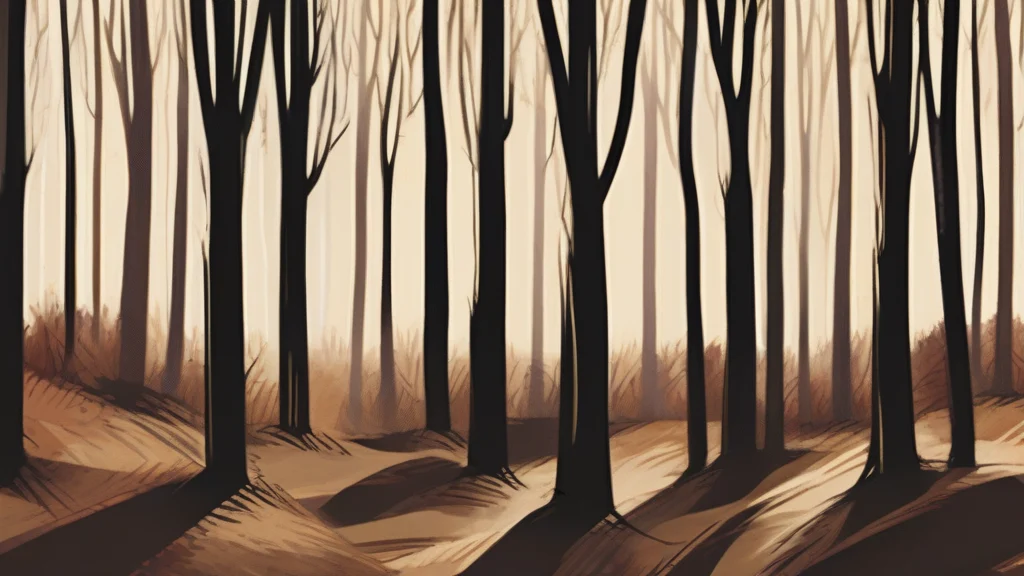
What does coppiced mean?
"Coppiced" describes trees or shrubs that have been cut down close to the ground — or sometimes to a low stump — so that vigorous new shoots sprout from the base, forming dense clusters of stems known as stools. The practice, called coppicing, is one of the oldest forms of woodland management, practised in Europe since prehistoric times to provide a renewable crop of poles, firewood, and craft materials without killing the tree. Species such as hazel, ash, lime, willow, and sweet chestnut respond especially well. In modern usage the word appears mainly in forestry, conservation, and nature writing, where coppiced woodland is celebrated for the wildlife it supports: open glades created by periodic cutting allow wildflowers, butterflies, and songbirds to flourish. The word functions as both past tense and past participle of the verb "coppice" and as an adjective describing shoots or products of the process. Its enduring use reflects a growing interest in traditional, sustainable land management.
Having been cut back to the ground or stump at intervals so that new shoots regrow from the base.
"The alders were last coppiced a decade ago and now stand in thick, even clusters."
(Of shoots, stems, or timber) produced by, or relating to, trees managed by cutting back to the base.
"Woven fences made from coppiced hazel have been a staple of the countryside for centuries."
Some English hazel stools have been cut and regrowing in cycles for over a thousand years — making them arguably among the oldest living organisms in Britain.
Reviewed by Deb Chak, Editor. AI-assisted content curated by RJS Tech Solutions LLP.
Etymology of coppiced
The word traces to Middle English "coppice" (earlier also "copse"), borrowed from Old French "copeiz", meaning a wood cut for fuel, derived from the verb "coper" (modern French "couper"), meaning to cut. This French verb ultimately comes from medieval Latin "colpare" or "colpus" (a blow, stroke, or cut), itself from Greek "kolaphos", meaning a blow or cuff. Cognates include "coup", "coupe", and "coupon", all sharing the underlying idea of a cut or cutting-off. The verb "coppice", and hence "coppiced", developed naturally from the noun in later usage.
Related word forms
How coppiced is actually used
"Coppiced" belongs chiefly to the registers of forestry, ecology, conservation, and rural history. It carries broadly positive connotations today, since coppicing is valued for biodiversity and sustainable timber production, though it can also evoke old agricultural labour. The verb is most often used in the passive ("was coppiced", "has been coppiced") rather than with a human subject.
Easily confused with coppiced
Pollarded trees are cut at head height or above (about 2–3 metres) to produce a crown of new shoots on tall trunks, whereas coppiced trees are cut at or near ground level.