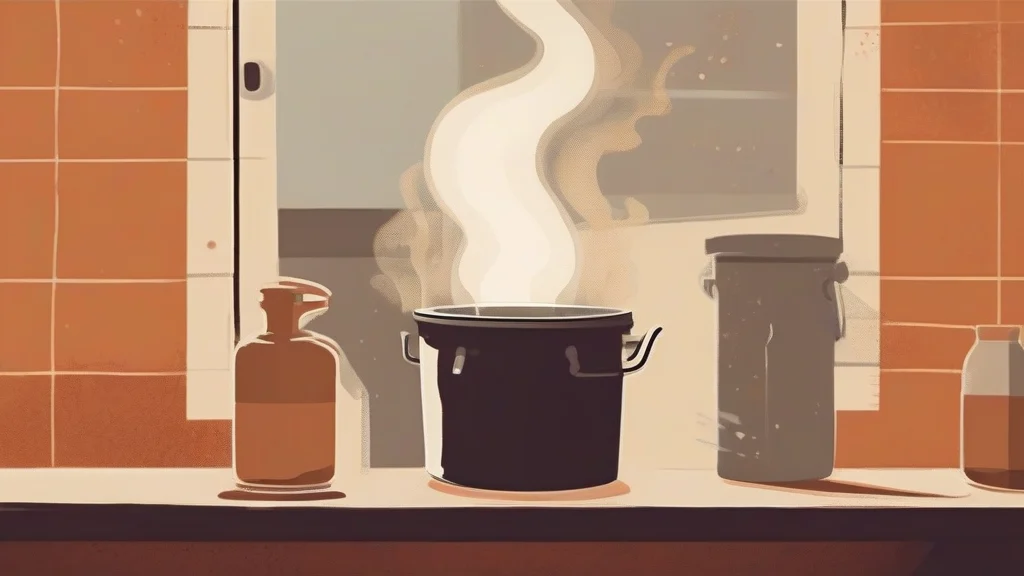
What does boil mean?
Boil is one of the most fundamental verbs in English, describing what happens when a liquid is heated to the point where it bubbles vigorously and turns to vapour — typically 100°C (212°F) for water at sea level. Beyond its literal scientific and culinary senses, where it governs everything from making tea to sterilising instruments, boil carries rich figurative weight: tempers can 'boil over', indignation can 'make your blood boil', and turbulent seas are said to 'boil'. The word also functions as a noun in two distinct ways: the state of boiling itself ('a rolling boil'), and a painful, pus-filled skin infection caused by bacteria entering a hair follicle. Its derivatives — boiler, boiling, boiled — extend its reach into engineering, weather, and everyday kitchen talk. Few words move so comfortably between physics, cookery, emotion, and medicine, which makes boil both versatile and essential.
To heat a liquid until it bubbles rapidly and turns to vapour; to cook food by plunging it into boiling liquid; figuratively, to seethe with anger or agitation.
"Leave the potatoes to boil for twenty minutes, then drain them well."
In figurative use, often appears in fixed phrases like 'boil over', 'boil down to', or 'make someone's blood boil'.
The state or point of boiling ('a rolling boil'), or a painful inflamed swelling on the skin caused by bacterial infection of a hair follicle.
"The doctor lanced the boil to relieve the pressure beneath the skin."
The plural of this noun is 'boils'.
Used only when referring to multiple instances of the skin infection; the state of boiling is uncountable.
"He was plagued by recurring boils on his neck throughout that humid summer."
Water boils at lower temperatures the higher you climb — on Mount Everest, it boils at around 70°C (158°F), so tea up there brews weak and slow.
Reviewed by Deb Chak, Editor. AI-assisted content curated by RJS Tech Solutions LLP.
Etymology of boil
The verb boil comes from Old French boillir (modern bouillir), from Latin bullire, meaning 'to bubble, seethe', itself a frequentative form of bulla, 'bubble'. This same Latin root gives us bulla-related terms such as 'bullate' (pimpled or blistered) in technical usage. The noun for the skin infection entered English from Old French bile or buil, sharing the same Latin ancestry, so the cooking verb and the medical noun are ultimately cousins rather than unrelated coincidences.
Related word forms
How boil is actually used
The verb is common in both literal cooking contexts and figurative emotional ones. In British English, 'boil' can take an informal extended sense meaning to wash something in hot water ('this shirt won't survive a boil wash'). The noun sense for the skin infection is fully standard but is less frequent than the verb in everyday usage.
Easily confused with boil
Broil means to cook by direct exposure to radiant heat (as in an oven's broiler or a grill), while boil means to cook in bubbling liquid.
Simmer refers to cooking just below boiling point with gentle bubbles, whereas boil involves vigorous bubbling at full heat.